Sunday, April 29, 2007

Tibet Activists Protest Beijing 2008 Olympics on Mt. Everest

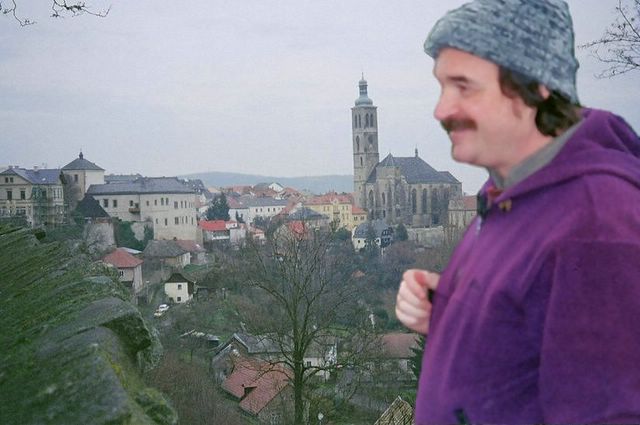
Tenzin Dorjee holding a protest banner at EBC, Tibet.


This just in : a protest at the Mt. Everest base camp within Tibet. Took some courage to do this since detention by the Chinese is no joke:

"Kathmandu – Three Tibetan independence activists, including one Tibetan-American, were detained by Chinese authorities today after demonstrating and unfurling a banner reading "One World, One Dream, Free Tibet 2008" in English, and "Free Tibet" written in Tibetan and Chinese, at Mount Everest.

The protest was held on the eve of the International Olympic Committee's announcement of the final Beijing 2008 Olympic torch relay route and as a Chinese team of climbers prepared a trial ascent of the mountain. If approved, China will take the torch over Mount Everest and through Tibet, a move that Tibetans and their supporters decry as offering international approval to China's brutal occupation of Tibet."

........"the detained activists are Tenzin Dorjee, male, 27, a Tibetan American and three Americans, Kirsten Westby, female, 29, Shannon Service, female, 31 and Laurel Mec Sutherlin, male, 29, all four from USA. They have been detained and interrogated for demonstrating and unfurling a banner reading "One World, One Dream, Free Tibet 2008" in English, and "Free Tibet" written in Tibetan and Chinese, at EBC, Tibet to protest the proposed taking of Beijing Olympic torch over Mount Everest and through Tibet. Is it not yet known whether these activists have been released after interrogation or taken into custody for further interrogation."

see also: Four Tibet activists held at Mt. Everest base camp

Thursday, April 26, 2007

Walking the plank for Iraq

Here's an interesting little squib from the latest issue of US News and World Report, which is usually too conservative to my taste, but Washington Whispers, and Inside the White House often have many juicy items:

Staying the Course Toward Shipwreck

"Pollster Stan Greenberg says that President Bush's arguments in favor of his Iraq policy have been effective only with conservatives so far, not with a wider audience of Americans. Only 35 percent of the voters support his "surge" of extra troops into Iraq-mainly conservatives, Greenberg says. "He's lost the country on that," adds the Democratic pollster. "Now it's all about the base." Greenberg believes that because Republicans are "walking the plank" for the president on Iraq, this makes them vulnerable in 2008. But the situation also presents difficult challenges for the Democrats, because Americans understand the dangerous consequences of withdrawal. But, says the pollster, if the United States is still in Iraq on Election Day 2008, "it will be a very big win for the Democrats, a tsunami."

"W" just extended tours of duty to 15 months. At present casualty rates, by this time next year 4293 US soldiers will be dead, and by then likely 30,000 US wounded.( 26,188 US as of 2/07) http://icasualties.org/oif/default.aspx

Meanwhile, the Maliki govt. is making no moves towards even sitting down and talking with the Sunni's. There was some recent talk of a conference in Turkey, but none of the factions wanted to go there.

As I have noted before the Sunnis and Shiites have been living in the same Mesopotamian area for over 900 years, so it is the height of folly to believe the US can resolve their rancor within 5 or ten years by being an occupation force. Basically, at some point its up to them, if they want to indulge in civil war.

It is very sad, very sad, that by summer of 2008, we will have lost over 4000. And Iraqi civilians, something like 31 a day.

The war in Iraq at present has become like Gallipoli, a military blunder where the Allies kept pouring in troops for a year, to no effect.

I am so angered at the Republicans, that if they want to walk the plank, I'll be there clapping my hands. But what a price to pay, likely 4773 dead by November 08. I would rather those troops, not already dead, get to come back alive.

I suppose one small thing we can do is let out representatives know that there should be some conference, say at a neutral site like Cyprus, where Sunni and Shiite representatives actually sit down and just keep talking to reach some sort of solution they can live with. The 'surge' and extended tours of duty, just keeps our troops there indefinitely acting as a shield for the Shiites, using the US troops to die , while hurting Sunnis, as payback for their sufferings under Saddam. Not good, not good. Very disturbing. Anyway, my thoughts on the subject, and btw I recommend reading Imperial Life in the Emerald City as an eye opener, if nothing else. Also Blood Money: Wasted Billions, Lost Lives, and Corporate Greed in Iraq
by T. Christian Miller.


Okay, my vent. Sorry, if it is a little hard core, but it is one of the things happening in the larger world we live in. I am curious how others feel.

Tuesday, April 24, 2007

Progress in Iraq -NOT!

Recently John Stewart on the Daily Show put together a series of clips of President Bush citing progress in Iraq:

" George W. Bush, January 2006: "There's progress. And it's important progress and it's an important part of our strategy to win in Iraq."
Bush, November 2005: "Iraq is making incredible political progress."
Bush, October 2005: "Iraqis are making inspiring progress."
Bush, September 2005: "Iraq has made incredible political progress."
Bush, April 2005: "I believe we're making good progress in Iraq."
Bush, March 2005: "We're making progress."
Bush, September 2004: "We're making steady progress."
Bush, July 2003: "We're making progress. It's slowly but surely making progress."

Actually, y'know what I think the president's problem is? Perhaps his definition of the word "progress." I have the reference book he uses when he doesn’t know what a word means: Mistaken P. Wrongingston's Diktionary of English. Let's see...ah, here we are. "Progress: Chaos caused by one's own incompetence that's portrayed as the result of others' malfeasance." ---The Daily Show "

Meanwhile as Phillip Carter concludes in an article over at Slate- Plan FUBAR:

" To sum up, it's more than a bit disingenuous to cast today's debate as one of Plan A versus Plan B. In fact, we've seen at least five major strategies implemented in Iraq, and all have failed, creating a legacy of bad blood that undermines our continuing efforts. Much of this failure owes to the naive belief that we can impose our will on the Iraqi people through our strategies, or win their support with a combination of security and reconstruction.

Gen. Petraeus and his brain trust have devised the best possible Plan F, given the resources available to the Pentagon and declining patience for the war at home. But the Achilles heel of this latest effort is the Maliki government. It is becoming increasingly clear to all in Baghdad that its interests—seeking power and treasure for its Shiite backers—diverge sharply from those of the U.S.-led coalition. Even if Gen. Petraeus' plan succeeds on the streets of the city, it will fail in the gilded palaces of the Green Zone. Maliki and his supporters desire no rapprochement with the Sunnis and no meaningful power-sharing arrangement with the Sunnis and the Kurds. Indeed, Maliki can barely hold his own governing coalition together, as evidenced by the Sadr bloc's resignation from the government this week and the fighting in Basra over oil and power.
Plan F will fail if (or when) the Maliki government fails, even if it improves security.

At that point, we will have run out of options, having tried every conceivable strategy for Iraq. It will then be time for Plan G: Get out."


Plan FUBAR:

Sunday, April 15, 2007

Imperial Life in the Emerald City

I just finished reading Imperial Life in the Emerald City by Rajiv Chandrasekaran. It is well written and an easy read.
Here is a short summary about it from Publishers Weekly via Amazon.com, and I quote:

"As the Baghdad bureau chief for the Washington Post, Chandrasekaran has probably spent more time in U.S.-occupied Iraq than any other American journalist, and his intimate perspective permeates this history of the Coalition Provisional Authority headquartered in the Green Zone around Saddam Hussein's former palace. He presents the tenure of presidential viceroy L. Paul Bremer between May 2003 and June 2004 as an all-too-avoidable disaster, in which an occupational administration selected primarily for its loyalty to the Bush administration routinely ignored the reality of local conditions until, as one ex-staffer puts it, "everything blew up in our faces." Chandrasekaran unstintingly depicts the stubborn cluelessness of many Americans in the Green Zone—like the army general who says children terrified by nighttime helicopters should appreciate "the sound of freedom." But he sympathetically portrays others trying their best to cut through the red tape and institute genuine reforms. He also has a sharp eye for details, from casual sex in abandoned offices to stray cats adopted by staffers, which enable both advocates and critics of the occupation to understand the emotional toll of its circuslike atmosphere. Thanks to these personal touches, the account of the CPA's failures never feels heavy-handed"

It adds to growing list of books about the early failures of the Bush Policy in Iraq, and it primarily covers the period from 2003 thru 2005.
It does not focus so much on the war itself, but the Coalition Provisional Authority and life in the Green Zone.

To read it is to become aware of the stupefying level of incompetence, cronyism, corruption, and cultural unawareness, of the personnel under Bremer, and of how Rumsfeld and Cheney, were influencing choices entirely through their own pre-conceived notions, and idealogical rigidities.

I found it to be a book hard to put down, as Rajiv has so many inside stories, it makes intriguing reading. Well worth your time, if you want to know how your tax dollars were wasted and mispent.

Sunday, April 08, 2007

Disinformation

For posterity's sake I am going to go ahead and post a whole article from a foreign newspaper. Found it on Goggle news under the title:

Iraq's alleged prewar ties to al Qaeda discredited

"Saddam Hussein's regime was not directly in cooperation with al Qaeda before the US invasion of Iraq, according to a declassified Defense Department report. Captured Iraqi documents and intelligence interrogations of Saddam Hussein and two former aides "all confirmed" that, the report said. The declassified version of the report, by acting Inspector General Thomas F. Gimble, also contains new details about the intelligence community's prewar consensus. It shows that the Iraqi government and al Qaeda figures had only limited contacts, and about its judgments that reports of deeper links were based on dubious or unconfirmed information, The Washington Post reported yesterday.

The Pentagon report had been released in summary form in February, the newspaper said. The Pentagon report's release came on the same day that Vice President Dick Cheney, appearing on a radio program, repeated his allegation that al Qaeda was operating inside Iraq "before we ever launched" the war, under the direction of Abu Musab al-Zarqawi, the terrorist killed last June.

"This is al Qaeda operating in Iraq," Cheney said about Zarqawi, who he said had "led the charge for Iraq." Cheney cited the alleged history to illustrate his argument that withdrawing US forces from Iraq would "play right into the hands of al Qaeda."

Senate Armed Services Committee Chairman Carl M. Levin (D-Mich.), who requested the report's declassification, said in a written statement that the complete text demonstrates more fully why the inspector general concluded that a key Pentagon office -- run by then-Undersecretary of Defense Douglas J. Feith -- had inappropriately written intelligence assessments before the March 2003 invasion, alleging connections between al Qaeda and Iraq that the US intelligence consensus disputed.

The report, in a passage previously marked secret, said Feith's office had asserted in a briefing given to Cheney's chief of staff in September 2002 that the relationship between Iraq and al Qaeda was "mature" and "symbiotic," marked by shared interests and evidenced by cooperation across 10 categories, including training, financing and logistics.

Instead, the Pentagon report said, the CIA had concluded in June 2002 that there were few substantiated contacts between al Qaeda operatives and Iraqi officials and had said that it lacked evidence of a long-term relationship like the ones Iraq had forged with other terrorist groups.

The CIA had separately concluded that reports of Iraqi training on weapons of mass destruction were "episodic, sketchy, or not corroborated in other channels," the inspector general's report said. It quoted an August 2002 CIA report describing the relationship as more closely resembling "two organizations trying to feel out or exploit each other" rather than cooperating operationally.

The CIA was not alone, the defense report emphasized. The Defense Intelligence Agency had concluded that year, that "available reporting is not firm enough to demonstrate an ongoing relationship" between the Iraqi regime and al Qaeda, it said.

But the contrary conclusions reached by Feith's office -- and leaked to the conservative Weekly Standard magazine before the war-- were publicly praised by Cheney as the best source of information on the topic, a circumstance the Pentagon report cites in documenting the impact of what it described as "inappropriate" work. "

What we have here is another example of the Cheney disinformation machine at work. He cobbles together just enough facts to suit the results that he wants, and spins it enough times so they in his own blood-thinned brain he likely thinks it is true. Who cares what the CIA, or DIA, or the Pentagon concludes.

Another recent exampe was Valerie Plame's sworn testimony before Congress, where she said that there was no substance to the statement that she was the one who sent her husband, Joe Wilson to Niger.

That had been a Republican talking point all through the early years of the Libby leak case. It was spun from Cheney and his office from the very beginning of the controversy. More Cheney disinformation.

I myself think Cheney is quite delusional, perhaps brought on , by him taking inordinate amounts of blood thinner. I also think it is important to take note of all the disinformation and outright lies he puts out.

Meanwhile in an article at the Pacific Free Press entiled :
Bush, Narcissus, and the Military Parasites I came across this neat little paragraph:

"Behaving as if their country was a banana republic, they put into the office an unread, ill-traveled, inarticulate, crude, callous, mean-spirited, trouble-making, revenge-seeking, Vietnam-evading, incompetent, loud-mouthed, cheap-shot, but consistently-bailed-out narcissist — largely because Bush and his propagandists proclaimed he had found God. "

Sunday, April 01, 2007

Hunter S. Thompson's mantle

Over at Rolling Stone magazine Matt Taibbi has taken up the mantle of Hunter S. Thompson with his Road Rage and Low Post articles:
Here is a few paragraphs from a Road Rage article of 3/22 which is not published online, so I can't link to it. The title of it was : Dick has a tough week.

" Amid all the spineless calculating toadies who road Bush's coattails to tit Cabinet jobs and fat Iraq contracts, Cheney is the one guy who genuinely believes in all of this bullshit. This has been his show all along and who else's could it have been really?

His counterpart, the president , after all is a snivling egomaniac trapped for all eternity in some unseemly infantile phase of personality development-and while W.'s hang ups are sufficiently incurable to keep him safely in denial in the face of abject failure and international outrage, there is no way the tortured vibes emanating from his id were ever purposeful or articulate enough to drive the world's greatest army across the ocean into Mesopotamia.

No, it had to be the indomitable will of a sinister Machiavellian creature like Cheney that made this Iraq disaster happen. Only that kind of personality could be capable of manipulating the intelligence community into signing off on bogus career-wrecking analyses and orchestrating from afar an absurd dog-and-pony show like the Hans Blix/U.N. inspections fiasco. Only a true believer like Cheney could steer this many huge bureaucracies so far off the cliff.

At every step of the way, the most brazen lies about Iraq were always Cheney's. It was Chaney who said unequivocally that Iraq had a nuclear program, Cheney who said the insurgency was in its "last throes," Cheney who said Iraq was the " geographic base" of the terrorists who hit us on 9/11...
And it was Cheney who said, with the assurance of either a sleepwalker or a psychopath or both, " I have not suggested there's a connection between Iraq and 9/11."

I try to check out Taibbi's The Low Post every week. Check at your library for Rolling Stone and past Road Rages.

Saturday, March 24, 2007

Gonzales A Go-Go

Well, the Time Coaster has been rather lazy as of late. Sorry. As Pico and Alvarado of Firesign theater fame would say, " Park and lock it! Not Responsible!

I do note with interest the lastest headline in the fray about the 8 fired attorneys, and Fredo , aka AG Alberto Gonzales.

"WASHINGTON — Attorney General Alberto Gonzales approved plans to fire several U.S. attorneys in an hourlong meeting last fall, according to documents released Friday that indicate he was more involved in the dismissals than he has claimed.

Last week, Gonzales said he "was not involved in any discussions about what was going on" in the firings of eight prosecutors that has since led to a political firestorm and calls for his ouster.

A Nov. 27 meeting, in which the attorney general and at least five top Justice Department officials participated, focused on a five-step plan for carrying out the firings of the prosecutors, Gonzales' aides said late Friday.

There, Gonzales signed off on the plan, which was drafted by his chief of staff, Kyle Sampson. The five-step plan approved by Gonzales involved notifying Republican home-state senators of the impending dismissals, preparing for potential political upheaval, naming replacements and submitting them to the Senate for confirmation."

So the import of this suggests that Mr. Gonzales was lying last week. I guess his defense would be total mental aphasia, .i.e. he has no recall of the Nov. 27th meeting. Apparently we are asked to believe he runs the Dept. of Justice and has no idea Kyle Sampson was working towards firing the 8.

One would gather then, that 'Fredo' thinks he can lie about such things and continue to serve in his office. We shall see.

For a more in depth analysis of this and the Karl Rove angle, read Sidney Blumenthal's What Bush is hiding in yesterday's Salon.

Here are excerpts:

"In the U.S. attorney scandal, Alberto Gonzales gave orders, but he also took them -- from Karl Rove, who plotted to turn the federal criminal justice system into the Republican Holy Office of the Inquisition": Sidney Blumenthal / Salon

And " "The disclosure of the e-mails establishing Rove's centrality suggests not only the political chain of command but also the hierarchy of coverup. Bush protects Gonzales in order to protect those who gave Gonzales his marching orders ~ Rove and Bush himself .... Bush's resistance to having Rove placed under oath or even having a transcript of his testimony appears to be a coverup of a series of obstructions of justice. The e-mails hint at the quickening pulse of communications between the White House and the Justice Department. But only sworn testimony can elicit the truth."

Farther along I came across an excellent article by Robert Scheer, who has a few choice words about Mr. Cheney:

"While he is still as dangerous as any cornered animal, Cheney stands brightly revealed as the main culprit in cherry-picking the evidence to make the case for a stupid, failed war. He has been exposed as a vindictive, inflexible ideologue, who attempts to destroy all who publicly disagree with him, such as former Ambassador Joseph Wilson and Wilson’s CIA agent wife, Valerie Plame Wilson.

- - - - His extensive ties and loyal political service to energy and defense companies such as Halliburton (which now, in a burst of honesty, is moving its headquarters to Dubai) reveal him to be a man of deep corruption.

As if we needed more evidence, the conviction last week of Cheney’s former chief of staff, Lewis “Scooter” Libby, provided ample evidence of the vice president’s bottomless cynicism. Surely congressional investigators will now ask Cheney, among other awkward questions, what he meant in that note he wrote to himself prior to the conviction, stating, “Not going to ... sacrifice the guy who was asked to stick his neck in the meat grinder because of the incompetence of others.” Who could have ordered Libby to break the law, other than his boss?

If the occupation had gone well, of course, Cheney wouldn’t be under fire. But as begins its fifth year, the only winners in this war are the aforementioned radical Shiites, Iran, mercenaries, al-Qaida, oil companies and military contractors such as Halliburton, which has scooped up $27 billion in contracts paid with our taxes. Now Halliburton is making its home in an undemocratic oil-garchy so distasteful to Americans that we wouldn’t let a company from there manage our ports.

Perhaps Cheney, in disgrace, can build his retirement cave there. "

from : Cheney is his own worst enemy

Monday, March 19, 2007

Interesting quote on the 4th anniversary of the Invasion

Richard Engel in his latest post from Iraq uses this quote. I found it to be of interest so I am requoting it here:

"In 1919, the British military’s official “eye-witness” to the World War I campaigns in Mesopotamia, Edmund Chandler, wrote in his war journal, “The Long Road to Baghdad” that Iraq's “thirsty soil has swallowed many empires.”
Chandler offered this warning to great powers like his own government, which he believed rushed to war in Baghdad without sufficient resources or a clear plan:

“Mesopotamia is a sinister, pestilential land. Not only has she devoured her own empires and kingdoms born of the soil, Ur of the Chaldees, the Assyrian Niveneh, three dynasties of Babylon, Ctesiphon of the Chosres; she has laid her blight on the greatest Empires of the West. It was in the malarious swamps of the Euphrates that Alexander caught the fever that cut short his life; it was at Ctesiphon that Julian and his Roman legions lost the Empire in the East.”

- War Zone Diary

Wednesday, March 07, 2007

Prayer Flag cairn

Here is one of the rock cairns with prayer flags and mantra stones that can be seen at Iron Knot Ranch. There are several of them at different spots on the land there. It made for a good photo. May all beings benefit.

Sunday, March 04, 2007

One more Prayer Wheel photo


I am adding one more photo of the prayer wheels just to give a different view. This is the central wheel. It has a railing around it so you can manually make it turn. Which is a meritorious thing to do, by the way.
The wheels are packed with mantra on paper and on microfilm.

Prayer Wheel building at Iron Knot


This is the octagon shaped building which houses the Prayer Wheels at Iron Knot Ranch in New Mexico. The walls are made of rasterblock, which can be stuccoed, just like adobe. I think it is one of the most awesome Dharmic installations in the West. One walks inside, and finds oneself immersed among seventeen spinning, prayer wheels, each loaded with millions of mantra. It really challenges one's ordinary perceptions when you are in there.

Prayer Wheels


Just recently got back from a Vajrakiliya retreat at Iron Knot Ranch in New Mexico.

Here is info about Vajrakiliya:
The wrathful practice of Vajrakilaya is an extremely powerful means to remove obstacles of any kind, including obstacles to health, longevity, activity, spiritual practice, and, ultimately, to realization of enlightenment. Performed at the close of the lunar year, Vajrakilaya practice averts and dispels negativity from the old year and establishes auspicious conditions in the New Year for ourselves and all beings.
Here is a look at the terrain at Ironknot which is about 14 miles east of Duncan, Arizona, but is actually in New Mexico.


The relatively new installation of Prayer Wheels has seventeen prayer wheels. Some are loaded with microfilm of mantra. They have electric motors so they turn 24 a day, all week, week after week, except sometimes the motors need maintenance. The central one is turnable by hand.
I came back via the Sunset Limited (Amtrak). It was an interesting journey.


Wednesday, February 07, 2007

Al Davis added to Mt. Rushmore in 2103


For a while my blogging efforts have been mostly political or , well some heavy posts. Now in a more light-hearted vein, here is a jpg I jizzed up largely for my brother Tom, who among other things is a Raiders fan.

It suggests that by 2103, Al Davis will be added to Mt. Rushmore. Apologies to Mr. Lincoln. The interesting thing is this post headline might get picked up somewhere, and the next thing I know, this blog gets more attention, than from any of my more weighty pronouncements. Oh, well. At least my brother dug it.

Saturday, January 06, 2007

Non to 2007?

Well to start the new year here's a droll story from France,found on the BBC web site:

French marchers say 'non' to 2007 :

Hundreds of protesters in France have rung in the New Year by holding a light-hearted march against it.
Parodying the French readiness to say "non", the demonstrators in the western city of Nantes waved banners reading: "No to 2007" and "Now is better!"

The marchers called on governments and the UN to stop time's "mad race" and declare a moratorium on the future. The protest was held in the rain and organisers joked that even the weather was against the New Year.

The tension mounted as the minutes ticked away towards midnight - but the arrival of 2007 did nothing to dampen their enthusiasm.
The protesters began to chant: "No to 2008!"

http://news.bbc.co.uk/2/hi/europe/6222153.stm

Then I read with interest an op ed by Walter Shapiro over at Salon entitled:
A decisive year for "the decider",

in which he says:" Nearly four years after the statues of Saddam Hussein were toppled in Baghdad, 2006 was the year that reality set in about the Mesopotamian mess. Outside the closed-loop universe of conservative talk radio and Fox News, there no longer is a constituency for vaporous visions of victory. "

And about the election: "Eleven months later, the seismic rumbles are still reverberating, as the Democrats won 29 new House seats, won six Senate seats and took over six additional governorships, including those in New York and Ohio. The most stunning statistic: Not a single Democrat running for reelection was defeated for Congress or governor."

That single statement alone undercuts those who say the democrats didn't win, it was the Republicans who manuvered themselves into a loss.


Meanwhile I find myself inclined to agree with Sen. Joe Biden. Here is a capsule of his statements this week:

" Sen. Joseph R. Biden Jr. (D-Del.), chairman of the Senate Foreign Relations Committee, said yesterday that he believes top officials in the Bush administration have privately concluded they have lost Iraq and are simply trying to postpone disaster so the next president will "be the guy landing helicopters inside the Green Zone, taking people off the roof," in a chaotic withdrawal reminiscent of Vietnam."

I have reached the tentative conclusion that a significant portion of this administration, maybe even including the vice president, believes Iraq is lost," Biden said. "They have no answer to deal with how badly they have screwed it up. I am not being facetious now. Therefore, the best thing to do is keep it from totally collapsing on your watch and hand it off to the next guy -- literally, not figuratively."

Thus the surge is a stop gap measure to postpone the collapse until 2008, at which W leaves and then blames the mess on the Democrats when a pullout finally happens. Cynical, - - - perhaps.

Yet as Tim Dickison at Rolling Stone notes when commenting on Biden's statement:

"It sounds like Biden’s given up on this war, which I take as a definitive sign of defeat. Say what you will about Biden, he took the costs and responsibilities of this war seriously. Unlike others in his party he really did try to focus on this as an American committment, not the president’s war.

Accordingly, he doggedly attempted to help the administration right the course in Iraq. But it’s now clear to him, and to everyone who saw the Saddam snuff film, that there’s no Iraq to be redeemed.

Vengeful sectarianism has trumped any overriding sense of national unity. And there’s nothing our military can do now to turn that tide. By supporting the Maliki government we’re simply sanctioning the actions of the Shiia Death Squads also known as the Interior Ministry.

There are no good solutions, but Bush’s plan to put more fingers in a dike that’s about to burst will not save his legacy from the harshest judgments of history. "

Okay 2007, here we go. It will soon be the Tibetan year of the Fire Pig. Whoa!

Sunday, December 17, 2006

3 Excellent Paragraphs from Salon

I was reading on the web this morning and checking some of the opinion pieces at Salon, and came across this great article by Gary Kamiya, entitled,"

A bombshell with a long fuse - The Iraq Study Group report may be DOA. But it shows the Washington establishment is finally confronting reality in the Middle East.

Here's a live link A bombshell with a long fuse, though you likely have to get a free site pass by watching an ad first.

And here's the 3 most excellent paragraphs which express what I have been thinking recently also :

"In fact, the greatest single failing of the ISG report was that it did not make its cautious military proposals -- to withdraw U.S. combat forces from Iraq by 2008, to push harder to train Iraqi troops -- contingent on the acceptance of its diplomatic ones. As many analysts have pointed out, the problem with training Iraqi troops is that Iraqi troops are more loyal to their sects than to the in-name-only government, and so training them might simply result in their being able to shoot at us more accurately in the future. For this reason and others, the ISG's plan would still be a Hail Mary pass even if its diplomatic recommendations were followed; if they are not, it has virtually no chance of success. By saying, "If you don't engage in diplomacy, you should withdraw U.S. troops immediately," the Baker group would have greatly increased the pressure on Bush to abandon his failed stay-the-course approach. And such a link would have given Democrats in Congress invaluable bipartisan support to demand a timetable for troop withdrawal -- something they don't feel they have enough political cover to propose now.

Of course, Bush would almost certainly have rejected this proposal anyway. As his entire disastrous presidency has shown, Bush is incapable of admitting he is wrong. With all the certainty of a simpleton whose brain has been taken over by One Big Idea, Bush has been convinced ever since 9/11 that history and God have chosen him to defeat an enemy of near-satanic menace. (Oddly, this Manichaean attitude is echoed by his also highly devout enemies.) In his mind, the current crisis is the Battle of Britain, and he is Winston Churchill, rallying the British people to their finest hour. Unfortunately, Bush has chosen the wrong World War II analogy. Iraq is not the Battle of Britain, it is Stalingrad. And Bush is not heroically standing fast like Churchill; he is stubbornly clinging to a doomed position, like Hitler. (If he insists on playing Churchill, there's a more applicable battle: Dunkirk.)

{or Gallipoli; during WW I, Churchill pushed for the Gallipoli operation, and long after any window of opportunity had passed for making it work, the Allied generals kept pushing more and more troops into the maw, to no useful end}

So for the next two endless years, the American people, the 140,000 American troops in Iraq and the Iraqi people will have to hang on for dear life as Bush, like Ahab chasing the Great White Whale of "Islamofascism," steers his course straight for Davy Jones' Locker -- with the only consolation being that he will take the Republican Party with him. But the Bush era will eventually pass, and America will be forced to deal with Mideast reality. "

As Kamiya concludes his article: "Bush will reject the Baker Commission's report, the neocons are already screaming in rage and panic, and it remains to be seen whether the Democrats will seriously press for any Mideast policy change that will lead to a showdown with Israel. But the facts on the ground are not going away. "

Sunday, December 10, 2006

An excerpt from Thomas Rick's Fiasco

Well, haven't posted for a while, which means I may have lost what readership I had. Sorry. The Thanksgiving holidays intervened with my time, and then you hit December and more time gets sucked away.

Anyway I finshed reading Thomas Ricks Fiasco: The American Military Adventure in Iraq . Reading this along with State of Denial will illuminate many things about the war in Iraq. I highly recommend reading Fiasco. Here is a bit from Amazon.com about the book:

"The main points of this hard-hitting indictment of the Iraq war have been made before, but seldom with such compelling specificity. In dovetailing critiques of the civilian and military leadership, Washington Post Pentagon correspondent Ricks (Making the Corps) contends that, under Rumsfeld, Wolfowitz and Feith, the Pentagon concocted "the worst war plan in American history," with insufficient troops and no thought for the invasion's aftermath. Thus, an under-manned, unprepared U.S. military stood by as chaos and insurgency took root, then responded with heavy-handed tactics that brutalized and alienated Iraqis. Based on extensive interviews with American soldiers and officers as well as first-hand reportage, Ricks's detailed, unsparing account of the occupation paints a woeful panorama of reckless firepower, mass arrests, humiliating home invasions, hostage-taking and abuse of detainees."

Then on page 408 we find this passage, which considering the occasion took place a few days short of two years ago are a devastating indictment of the 43rd President taking any action on what has turned out to be the truth back in 2004. It is slightly more than 4 paragraphs, but since I am recommending the book and citing it, I hope the powers that be don't get upset. Okay here goes:


"In December 2004, two unvarnished official reports hit the White House. The first was a somber assessment by the CIA station chief in Baghdad, at that point, the agency's largest station. Called an aardwolf in agency jargon, the assessment enjoys special status under CIA regulations. It cannot be edited by the ambassador, and it is delivered directly to the agency's director. Just a few other copies are distributed, and only to people at the top of the government, with recipents including the president, the secretaries of state and defense, and the national security advisor. "We face a vicious insurgency, we are going to have 2,000 dead, the CIA station chief's report stated, according to a senior U.S intelligence official with direct access to the document.

A few days later on December 17, 2004, according to a former senior administration official, President Bush received an extensive briefing on the situation from Army Colonel Derek Harvey, a senior U.S. intelligence expert on Iraq. Unlike most U.S. military intelligence officials involved in the region, Harvey understood Arabic, and also had a Ph.D in Islamic studies. He had a far less rosy few than what the president had been hearing. CIA and NCS officials who already had received the longer four-hour version of his briefing sat in. The insurgency was tougher than the American officials understood, Harvey told president according to three people present at the meeting. "It's robust, it's well led, it's diverse. Absent some sort of reconciliation it's going to go on, and that risks a civil war. They have the means to fight this for a long time, and they have a different sense of time than we do, and are willing to fight. They have better intelligence than we do." The insurgents had managed to mount about twenty-six thousand attacks against U.S. forces and Iraqis during 2004 and the trends weren't good.

The president wanted to know where Harvey was coming from. Who was he? And why should his minority view, so contrary to the official optimism, be believed. Harvey explained that he had spent a good amount of time in Iraq, that he had conversed repeatedly with insurgents, and had developed the belief that the U.S. intelligence effort there was deeply flawed.

The other officials present weren't entirely at ease with Col. Harvey and his perpective. " There was always the view that Harvey was a little bit over the top," especially in his certainty that he was right and everyone else was wrong, said a former senior administration official.

Okay, what about the Syrian role? the president asked.

One ot the CIA officials spoke up to say that his agency didn't see clear financing coming from Syria. The CIA had long thought that Harvey and other military intelligence figures were overemphasizing the role of Syria and foreign fighters in Iraq. No, Harvey bluntly responded with striking specificity, in fact , we do. "We see four different tracks of financing from Damascus. All to Ramadi, to the tune of $1.2 million a month. And it is based in a very Arab way, on relationships and shared experiences. And all the sigint [sinals intercept intelligence] isn't going to tell you that". But don't focus on the foreign fighters, Harvey told the president, breaking a bit with the orthodox view in military intelligence . We've zeroed in on them too much because our intelligence apparatus can intercept their communications. But they aren't at the core of the Iraqi insurgency, which is "the old Sunni oligarchy using religious nationalism as a motivating force. Thats it in a nutshell."

Its fairly easy to see that events in Iraq have unfolded exactly as Col. Harvey was saying they would back in December 2004.

At this point General Abizaid is saying give us 6 more months and perhaps 20,000 more troops, and the situation will get stabilized. More likely by then there will be 3,500 dead US soldiers, an additional 5,000 more wounded, and the civil war will be just as nasty as it is now.

Just another example of this Adminisration ignoring intelligence because it does not fit their idealogical notions, and then compounding their blunders. And also by late in 2007, their incompetence will likely cost us 3 quarters of a trillion dollars. Well, as the old Houston Post motto used to say, "Let facts be submitted to a candid World."

Monday, November 20, 2006

New Popular History of Tibet by Thomas Laird


The Story of Tibet: conversations with the Dalai Lama - by Thomas Laird.


I was checking out the new book section at the local library, and I found this new popular history of Tibet entitled : The Story of Tibet: conversations with the Dalai Lama - by Thomas Laird.

I started reading it and immediately found it an easy read and engaging. I am not going to do a review here, since I am just beginning on it, but I would recommend it highly as it is well done, and you get a thorough account of Tibets history as viewed by the Dalai Lama himself.

There is a very good passage on page 367, which I will quote several paragraphs of, as it elucidates His Holiness's view of the Tibet/China situation in 2006 and on into the near future.
The interviewer is Thomas Laird the author :

What is your prediction for the future?

DL:"I believe truth has its own strength and we must retain our faith in truth", he answered, returning to the theme he referred to in our first interviews. "Of course guns have their own unique strength. But the strength or force of a gun is short or temporary. Temporarily it is decisive, but in the long run it is weak. The power of truth stands up. Truth always remains unchangeable. Then there is another manifestation of these two. The power of guns is often not compatible with truth and very much depends on untruths or lies. So with guns, there are usually lies and destruction. When governments keep so many state secrets, this is a sign of weakness despite military strength. If a government is compelled to keep secrets from its own people, this is a weakness. Also in China, the government has kept too many secrets from its own people. This is not good. Tibetans do not have guns, but we are very strong.
We have suffered a lot. We have been victimized, but still (tell) the truth. There is no lie, no effort to hide our mistakes. We are open. Anybody is welcome to look at what we are doing. We are trying to be open, and this is a manifestation of the truth and this is a real strength. That is why I feel that , for the future, there is hope and it is positive."

"Some people might not see the situation you face so positively, " I said.

DL:" If you look at the Tibet situation locally," he replied, " then it seems hopeless, desperate, and it seems our time is running out. But in reality the Tibetan problem is not hopeless at all, not like problems from a civil war. Our problem is we had a conflict with a new guest with a gun who came without a proper invitation. But things change. The Tibet issue is very much linked to the situation within China proper. China, no matter how organized, is part of the world, (and) change is part of the world. In the last fifteen to twenty years China has changed dramatically, and this change will continue. The totalitarian system has changed and has lost its ideology, and politicians seem primarily concerned with power. Sometimes I feel I am a more genuine Communist than them.

"The existence of a totalitarian government requires military force.," the Dalai Lama continued firmly. " If it does not have any proper sort of aim or ideology, just power, such a system is unhealthy and is bound to change. Because of different technologies like the Internet, it is impossible for any government to keep so many secrets or secrecy, and this makes change inevitable. Therefore, change is already taking place, and the time for totalitarianism is running out. On the Tibetan side, the spirit is strong, and support from the outside world is increasing. I feel from a wider perspective, there is very much hope".Posted by Picasa

Wednesday, November 01, 2006

Pieta


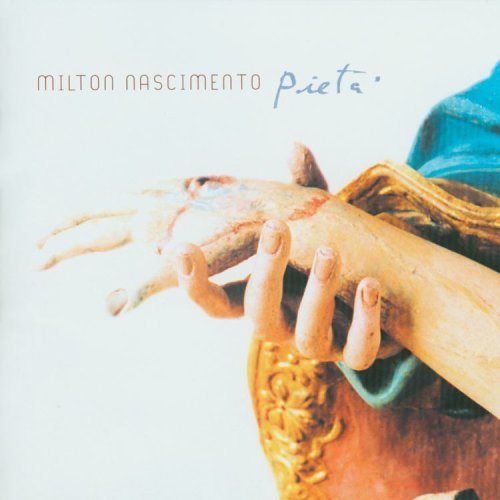
Pieta -album by Milton Nascimento

Recently I got a hold of a copy of Milton Nascimento's album of 2005 entitled Pieta. Was unaware that it had come out, because 1) I was over in Europe then, and 2) I had lost interest in some of Milton's albums of the late 90s and early aughts. At any rate I can report that this release is delightful, and before I go further let me quote the short review over at Amazon.com:

"Having recorded a series of highly influential releases during the seventies and early eighties -- and captured a worldwide following in the process -- Nascimento seemed to lose his way for a spell. But thankfully, he is back on track, praising the Eternal Feminine as personified by his mother and other strong women who have touched his life. The theme is not new to him -- the concept of a female twin soul/guardian spirit has recurred in his work since the beginning -- but this is the first time he has dedicated an entire album to the age-old anima/animus duality. His trademark baritone-to-tenor, crowned by an ethereal yet searing falsetto, is companioned by a roster of women altos (Simone Guimarães, Marina Machado, and Maria Rita Mariano) whose voices envelop his like darkly iridescent angel wings. Old friends like lyricist Fernando Brant and bassist Lô Borges, who have been with him since his youthful Clube da Esquina days, are on hand, as are icons from Brazil (arranger Eumir Deodato) and the U.S.(Pat Metheny, Herbie Hancock). Although Nascimento's one-time naive sophistication has undeniably been superceded by a knowing, jazzy neo-primitive thrust, this is his finest effort in years and thus, an essential must-have. --Christina Roden "

I first was turned onto the music of Milton Nascimento while in the Peace corps in Jamaica. A member of the German Volunteer Corps in Jamaica, Vinnie, lent me a 100 min cassette tape that was all his music. I remember sitting on the RoofTop bar in Papine, just outside of Kingston, and the view to the south was tremendous; you could see the causeway going out to Port Royale and then south of that the Caribbean sea. Looking at that view, I would recall the song Cravo E Canela (Clove and Cinnamon) by Nascimento , and I could almost sense the energy of the South American continent. Btw that’s an incredible song, one can sense the heart of Minas Geraes and Brazil in it. I duped that tape and continued listening to his songs the rest of the time I was there. And when I got back to the States, I ended up spending a lot of time and effort to get all the songs of his that were on the tape, on albums.(This was back when lps still predominated) It ended up taking something like 14 albums to get that mix.

In the end though the reason I went to so much trouble to recollect all those songs, is the music of Milton Nascimento at its best, is so captivating, sometimes otherworldy, and always filled with heart and soul. He sometimes uses too much lush orchestration which veers into 'cocktail' music for me, but on the other hand his music can reveal incredible South American vistas at times. Nascimento exhibits sheer musical genius in many of his songs.

I did move away in my interest in his albums over say the last ten years, but this album is alive and brings his music up to date, without dipping into any trite trends. The first song on Pieta, A Feminina voz do cantor is one of the most moving songs I have heard in a long time. Its like Nascimento taps into some subconscious feeling that most anyone can relate to. Which makes for great art. Another similarly moving song is Beira-Mar Novo, in which Milton has vocal backing by a group of young Brazilian teens- Meninos de Aracuai.

All the songs have a ‘alive’ sparkling quality. I can recommend it highly, especially if one already likes Brazilian jazz, or likes his music to begin with.
Posted by Picasa

Wednesday, October 25, 2006

The Foreigner's Gift


The Foreigner's Gift by Fouad Ajami

Sometimes time passes by between one post and the next. For one thing I have been reading. And have just finished reading Fouad Ajami's The Foreigner's Gift: The Americans, the Arabs, and the Iraqis in Iraq . Okay more on Iraq. The more I learn about Iraq, the more disquiet I feel about the whole project. Before I go further here is the outline type review found at Amazon.com:

"The fall of Saddam Hussein's brutal regime brought the first glimpse of freedom for Iraq and unleashed elation, resentment, and chaos. On the one hand, there is hope: the Iraqi people have their first chance at independence. On the other hand, there is despair: the country is exploding with violent sectarian and political power struggles. Through it all, Iraq has remained an enigma to much of the world. What is it about this country that makes for such a seemingly intractable situation? How did Iraq's particular history lead to its present circumstances? And what can we fear or hope for in the coming years?

Fouad Ajami, one of the world's foremost authorities on Middle Eastern politics, offers a brilliant, illuminating, and lyrical portrait of the ongoing struggle for Iraq and of the American encounter with that volatile Arab land. Ajami situates the current unrest within the context of Iraq's recent history of dictatorship and its rich, diverse cultural heritage. He applies his incisive political commentary, his broad and deep historical view, his mastery of the Arabic language and Arabic sources, and his lustrous prose to every aspect of his subject, wresting a coherent, fascinating, and textured picture from the media storm of fragmented information.

In the few years after the Iraq war began, Ajami made many trips to that country and met Iraqis of all ethnicities, religions, politics, and regions. Looking beneath the familiar media images of Iraq and the war, Ajami visits with individuals representing the breadth of Iraq's populace, from Sunni leaders and Shia clerics to Kurdish politicians and poets, Iraqi policemen, and ordinary people voting for the first time in their lives. He also hears from American soldiers on the ground, and the result of all his encounters is an astonishing portrayal of a land that has emerged as a crucial battleground between American power and the wider forces of Arab religious and political extremism."

This is a fascinating book. Prof. Ajami has a distinctly different prose style which spirals around a subject; that is starts around the edges of a subject and then circles inward. It is not unlike the spirals on the book cover of Islamic tile art. It takes awhile to get used to, but he illuminates much in his own way.

He actually sees some good thing coming out of the invasion and occupation of Iraq. And he brings an unique perspective being a Shia Muslim of Lebanese descent.

The gift supplied by the 'Foreigners' is in this case, the removal of Saddam and the bringing of democracy to Iraq.

The thing is events since I even recently read this book, has already overtaken the somewhat hopeful prognostications of Mr. Ajami.

For example here is what Mortimer Zuckerman in the Oct. 15th issue of US News and World Report says about the undertaking in a opinion piece entiltled, " A Sad Litany of Failures. And I will quote just two paragraphs:

"Nobody was entitled to think the Iraq venture would be roses all the way, given that Saddam Hussein had repressed Iraqis for three decades, depriving the nation of a cadre of local leaders like, say, Hamid Karzai in Kabul. But we had a vision of what might have been achieved. It would not be too much to say it was a noble vision, but it was not one grounded in the hard reality of a fractured, multiethnic society. Saddam held his citizens down by brutality and cunning, not giving religious leaders a key role, as we did, yet subtly balancing religious rivalries one against the other. Shiites account for some 60 percent of Iraq's population, and for them democracy means empowerment. But the Sunnis, who had dominated under Saddam for so long, were never going to accept minority status, and the Kurds were not going to accept anything less than de facto sovereignty, which they obtained after the 1991 Gulf War.

Occupiers. Alas, whatever chances we may have had to overcome these difficulties have been torpedoed by the breathtaking incompetence of the Bush administration in managing postwar Iraq. Senior officials from the president on down ignored warnings that we might win the war and lose the peace. Gen. Tommy Franks won the battle for Baghdad but seemed to feel that planning for the postwar period was someone else's job. But whose? We sent an inept group of operatives to run Iraq, often appointed because of their political leanings. Whatever support we originally enjoyed there we began to lose when we allowed criminals to rampage. Then the Americans, fabled for their can-do efficiency, failed again and again to deliver electricity, water, and, most critically, security. Today, the violence is estimated by one account to have cost more than 600,000 Iraqis their lives. "

What I notice hasn't been mentioned is that this October has not only been the worst month for Americans this year, it has been the worse since November 2004. The situation has worsened. Much of the territory in Iraq is really controlled by either Sunni or Shia militias now. Our troops will be lucky to get out of there, with even some semblence of government and order restored. And there is no guarantee, that even if US forces stayed there until 2016, that the day after all US troops are gone, all hell might break loose again. Indeed, the hell on earth scenario is already happening for this corner of our planet.Posted by Picasa

Wednesday, October 18, 2006

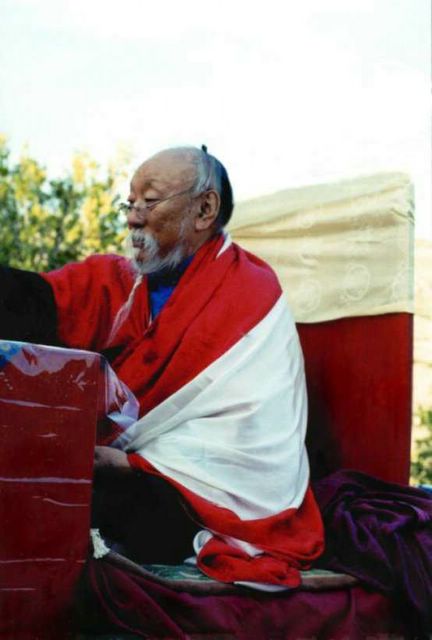
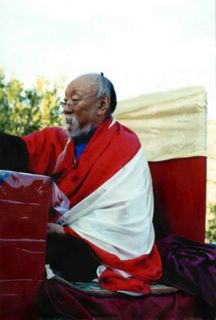
Chagdud Tulku Rinpoche


at IronKnot Ranch, April 2001

I recently substantially added to the biography of Chagdud Tulku Rinpoche over at Wikipedia . And added the photo above which I took I believe April 5th, 2001 at IronKnot Ranch in New Mexico. I am going to go ahead an add to this blog, what I wrote, because I know over time, the bio at Wikipedia will get edited, and I fear 'dumbed' down or keel-hauled. To elaborate I don't like to see valid information subtracted from an article, just because someone doing an edit doesn't like the information presented. Okay . Here goes. It will make a huge post, but hopefully it will be of some benefit:
Posted by Picasa

H.E. Chagdud Tulku Rinpoche (August 12, 1930-Nov. 22, 2002) is a renowned teacher of the Nyingma school of Tibetan Vajrayana Buddhism. He was renowned in the West for his teachings, and also for his melodic chanting voice, his artistry as a sculptor and painter, his limitless compassion, and his sense of humor . He was the source of treasured Nyingma lineage transmissions for the thousands of people whom he taught in North and South America, Asia, Australia, and Europe.

He was born in the Tromtar region of Kham [Eastern Tibet] in 1930. His father was Sera Kharpo, who was actually a lama in the Gelugpa sect. His mother was Dawa Drolma, who was widely considered to be an emanation of Tara, and had a profound influence on her son's spiritual life.

By the time he was three years old he was recognized as the incarnation of the previous Chagdud Tulku, and soon thereafter traveled to Temp'hel Gonpa, a monastery about two or three days by horseback from Tromtar. As he recounts in his autobiography, The Lord Of The Dance:

“For the next seven years, until I went into three year retreat at the age of eleven, my life would alternate between periods of strict discipline in which my every move would be under the surveillance of my tutors and interludes in which my suppressed energies would explode. Throughout, I had many visions, many clairvoyant experiences, many extraordinary dreams, and within these, I sometimes had glimpses of absolute open awareness.”

After this retreat he received numerous teachings, empowerments, and oral transmissions, from various spiritual masters. One of them, Sechen Rabjam Rinpoche, told him that Tara meditation would be one of his major practices. In 1945 shortly after completing his first three year retreat he went to see His Holiness Khyentse Chökyi Lodrö Rinpoche. From Chökyi Lodrö Rinpoche he received the Rinchen Tangyud empowerments, and caught his first glimpse of Dilgo Khyentse Rinpoche, who was attending the empowerments. By 1946 he entered his second three year retreat, this time under the guidance of the Tromge Trungpa Rinpoche. Near the conclusion of this retreat, the death of Tromge Trungpa forced him to leave before its completion. He then returned to Chagdud Gonpa in Nyagrong, and after staying there for awhile, proceeded on a pilgrimage to Lhasa with an entourage of monks.

He then did an extended retreat at Samye, the monastery built by Guru Padmasambhava, and afterwards attended empowerments given by H.H. Dudjom Rinpoche,who would become a main teacher as well as a source of spiritual inspiration for him. After this in 1957 he stayed for a year in Lhasa, Tibet, in the same household as Khenpo Dorje, whom he regarded as his root lama.

During 1958, his last year in Tibet, Chagdud Tulku was advised to marry in order that he would have a companion and helper in the unsettled times to come. He later wed Karma Drolma, the daughter of a wealthy landowner in Kongpo. Later on in exile in India, they would have a son and a daughter, Jigme Tromge Rinpoche and Dawa Lhamo Tromge.

Following Tibet's invasion by China in 1959, Chagdud Tulku escaped along with Khenpo Dorje to India, after enduring hunger, and many close calls, where it looked like they would not make it out. His route took him through Padma Kod region of Tibet, and his party came out from there into the Nagaland area of India.In India Rinpoche lived in a number of Tibetan refugee resettlement camps - Kalimpong, Orissa, Dalhousie, Bir, and Delhi. He practiced Tibetan medicine , and was much in demand as his fellow refugees had trouble coping with the heat, and subtropical diseases found in India.

A year or two after his arrival in India, Rinpoche entered a retreat in Tso Pema, a lake sacred to Guru Rinpoche, located near the city of Mandi in Himachal Pradesh. At this location he met Jangchub Dorje, a primary disciple of Apong Terton and a lineage holder of this great treasure revealer's Red Tara cycle. Jangchub Dorje gave him empowerments for the Red Tara cycle, and then he re-entered into retreat and signs of accomplishment in the practices came very swiftly. Later, when he began teaching in the West, Red Tara sadhana would become the meditation most extensively practiced by his Western students. While he was living in Bir, circumstances there gradually led to an estrangement with Karma Drolma, and eventually they separated.

After giving a teaching in Kulu Manali, the Dalai Lama extended an invitation for Rinpoche to go to the United States and teach, contingent upon him getting a visa. It was at this time that he moved to Delhi, and lived in Majnukatilla, a TibetanCamp on the banks of the Jamuna river. The process of trying to get a visa went on for three years, and was ultimately unsuccessful. During this time period he met his first Western students, but he also caught malaria and nearly died, and was saved by an Indian doctor who finally made the correct diagnosis of what was ailing him.

In the fall of 1977 empowerment cycles were given in Kathmandu, Nepal by H.H. Dudjom Rimpoche in order to propagate the sacred lineages to a new generation. Chagdud Tulku decided to travel there in order to receive all the empowerments of the Dudjom treasures from Dudjom Rimpoche. Hundreds of tulkus, scholars, yogis and lay practitioners gathered at Tulku Urgyen Rinpoche's monastery for these empowerments. About his experience he says this in his autobiography:

“ During my stay in Nepal I received empowerments and oral transmissions for all the treasures he had discovered in this life and in his previous life as Dudjom Lingpa. It was a wealth of practices whose splendor is unsurpassed, and deep within me I formed the aspiration to offer this transmission to others through empowerment and teaching.”

While attending them Chagdud Tulku met and older lama from Western Tibet, Lama Ladakh Nono, who was known for doing mirror divinations. He subsequently did a mirror divination for Chagdud and told him he should go to the West and benefit many people there by teaching the Dharma. He also predicted that a Western woman would come into his life and that this would be good.

He continued to stay in Nepal on into 1978 in order to attend a new series of empowerments in the Choling Tesar cycle given by His Holiness Dilgo Khyentse Rimpoche. It was while attending one of these empowerments, that a Western woman , Jane Dedman, approached Chagdud Rinpoche with the offering of a white scarf and a jar of honey. Afterwards he invited her to lunch, and shortly after this he gave her some teachings. A month or so later he accepted her offer to serve as his attendant in retreat after the empowerments. This retreat lasted for several months, after which Dudjom Rinpoche among other things suggested Chagdud go to America to teach.

After many months of waiting he was finally granted a visa and landed in San Francisco on Oct. 24, 1979. Shortly after this, he married Jane in South Lake Tahoe, Calif. The early years of his teaching in the Americas was spent in Eugene, and Cottage Grove Oregon. In 1983, at the request of his
students, he established Chagdud Gonpa Foundation.He soon ordained his first lama, a Western woman named Inge Sandvoss, as Lama Yeshe Zangmo.

Additionally in the time period of 1980 through 1987 he gave many teachings and invited many other renowned Lamas such as Dudjom Rinpoche, Tulku Urgyen Rinpoche, Kalu Rinpoche, and Kyabje Penor Rinpoche to Oregon where they bestowed many empowerments and teachings. He also helped set up Padma Publications which eventually published his two books: The Lord of the Dance, and Gates to Buddhist Practice. Padma Publications also, with the assistance of Richard Baron began the monumental task of translating from Tibetan into English, Longchenpas Seven Treasuries , of which three volumes have been published to date.

In 1987 he returned to Tibet for the first time since 1959. He traveled to Kham, visiting the three monasteries of his youth ,and actually bestowed empowerments to the monastic staff there. His son, Jigme Tromge Rinpoche, traveled with him to Tibet and the next year immigrated to the United States, entering a three-year retreat a few months after his arrival.
Then in 1988 after land was acquired in the Trinity Alps of Northern California, the main seat of Chagdud Gonpa Foundation was created there as Rigzin Ling. It was here that Chagdud Tulku offered the empowerments and oral transmissions of the Dudjom Treasures in 1991, and several years later, of the supreme dzogchen cycle, Nyingt'hig Yabzhi.

In 1992 he received an invitation to teach in Brazil and he would become a pioneer insofar as spreading the Dharma in South America. Throughout the 1990s he maintained an extensive teaching schedule, put many of his senior students into three year retreats, and helping to establish many Chagdud Gonpa centers throughout the Western Hemisphere. These include, more than 38 Dharma centers under Chagdud Tulku's supervision and inspiration, in America, Brazil, Chile, Uruguay, Switzerland and
Australia. The best known are Rigzin Ling in Junction City, California and Khadro Ling, his main center in Três Coroas, Brazil.

In all his teachings he was known for stressing pure motivation in doing spiritual practice. He once wrote, "In the course of my Buddhist training, I have received teachings on many philosophical topics and meditative methods. Of all teachings, I find none more important than pure motivation. If I had to leave only one legacy to my students, it would be the wisdom of pure motivation. If I were to be known by one title, it would be the 'motivation lama.'"

In this context ‘pure motivation’ means the cultivation of bodhicitta , which is the enlightened intent of doing practice for the benefit of oneself, and all other sentient beings.

In 1995 he moved to Khadro Ling, in Río Grande do Sul, Brazil, and it became the main seat of his Dharmic activities, for the rest of his life. In 1996 the first Brazilian Dzogchen retreat took place at Khadro Ling and a large Guru Rinpoche statue was created there. In the next few years, he traveled in South America, giving teachings in Uruguay, Argentina, and
Chile, in addition to different parts of Brazil. He also continued to travel to his centers in the United States, and made frequent visits to Nepal, a return to Chagdud Gompa in eastern Tibet and a visit to mainland China. During this same time period, in addition to leading Drubchens and month long Dzogchen retreats, he also trained his students in the sacred arts of
sculpture and painting, as well as ritual dance, chanting, and music.

In 1998, construction began on the lha khang (temple) of Khadro Ling. In July 1998, the empowerments of the Taksham Treasures were bestowed by Terton Namkhai Drimed in the still incomplete temple. This temple was followed by an enormous prayer wheel project, perhaps the largest in the Western Hemisphere, then eight magnificent stupas, and a monumental statue of Akshobhya Buddha. In the same period, in Parping, Nepal, Rinpoche built a new retreat center where eight people began training
according to the Kat'hog tradition under Kyabje Getse Tulku.

While Chagdud Rinpoche kept up a tremendous amount of Dharmic actvity, in the last few years of his life he was somewhat slowed down by diabetes, and in 1997, he entered a clinic and was diagnosed with a serious heart condition. In the last year of his life Rinpoche's body began to sabotage his outer activities. He tired more easily, and travel became difficult. In 2002, he cancelled a trip to the United States, which had been scheduled for October, and instead entered strict retreat.

In the last week of his life, he concluded this retreat on Tuesday, November 12th , worked with a student artist to complete a statue of Amitabha, talked with many of his students, and led a training in p'howa (transference of consciousness at the moment of death) for more than two hundred people. He continued teaching with great vigor until about 9 pm on Saturday night
November 16th. Then on Sunday morning of the 17th, at about 4:15 a.m., Brazilian daylight time, he suffered massive heart failure while sitting up in bed.

After this Rinpoche remained in a state of meditation for almost six full days.The ability to remain in meditation after the breath stops is known as (t'hug dam).His son Tulku Jigme Rinpoche described this in a release to the Brazilian press:

“After his last breath, my father remained in a state of meditation foralmost six full days that prevented the usual deterioration of hisbody. The ability to remain in a state of meditation after the breath stops iswell-known among great Tibetan masters, but circumstances have rarelyallowed it to occur in the West. Chagdud Rinpoche remained sitting ina natural, lifelike meditation posture, with little visible change ofcolor or expression. During that time, no one touched his body.

Until the sixth day, Friday, November 22rd, Rinpoche showed no physical signs that his meditation had ended. In the interim we were inconstant consultation with a lawyer and other officials about local customs and regulations. Friday midday, his meditation ended and his mind
separated from his body. Within hours, his appearance changed. He took on the signs typical of those occurring within the first 24 hours of death.”

Afterwards his ku dun (the physical body) was flown to Kathmandu, Nepal, and to the retreat center in Parping. During the forty-nine days that followed, Getse Tulku Rinpoche and Jigme Tromge Rinpoche led ceremonies in Parping,to purify inauspicious circumstances to Rinpoche's rebirth and to generate great merit through offerings and practice.

A year later on the full moon of December 8, 2003, Rinpoche's cremation was held on Jigme Rinpoche's land in Parping, with Kyabje Mogtza Rinpoche, one of the highest lamas of Kat'hog Gonpa, serving as Vajra Master. Hundreds of Rinpoche's students gathered, to mourn the loss of his direct physical presence, and made prayers and offerings for his eventual rebirth.

His wife Chagdud Khadro and his son Jigme Tromge Rinpoche continue to teach and carry on Chagdud's many projects and practices.