
I really enjoyed the interview with Sidney Blumenthal over at Welcome to WorkingForChange. I am posting a short bit of it here. For the full interview here is the raw link: http://www.workingforchange.com/article.cfm?itemid=21368.
Sidney Blumenthal is "both a trenchant, learned journalist and a tested political counsel who served as a former special advisor to both Bill and Hillary Clinton in the White House, Sidney Blumenthal has been writing commentary on politics regularly for Salon.com and The Guardian since 2003. Blumenthal is a wordsmith with lacerating insight."
Okay here is just a small part of the "Buzzflash" interview:
"BuzzFlash: Much of what you've written so accurately and trenchantly points to the failure of the Bush administration to achieve its own stated goals. Really, Iraq is only the most tragic and at the same time, the most ludicrous example of how they have constantly shifted their goals and even failed every time they've shifted them. It might have been something extremely different if this were a radical government, and actually had succeeded at something beyond making the wealthy wealthier and leading us to the point of bankruptcy. I guess those are their two successes in some weird sort of way.
But you write frequently about their failures -- that, by their own standards, they've failed. Of all the many reasons they've given for going to Iraq, none seems to hold up. What we're left with is that they're stopping terrorism there, when we're really just mediating a civil war at this point between Sunnis and Shiites. Given all this failure, how are they able to continue to rule with the trump card of "you need us to fight against terrorism"? I know you can kind of manufacture "truthiness," as Stephen Colbert says on television, with big bad scary commercials with wolves in them. But the reality is failure, as you've pointed out. How can they get away with this?
Sidney Blumenthal: For every failure, Bush develops a new front where he insists that he is required to save us from a new threat. The Bush universe of threats is a constantly expanding universe as he moves to politically higher ground, escaping from failure after failure. He's not only radical, but the consequences of his radicalism have been catastrophic. These people have been deeply incompetent.
Now, some of the things that they're incompetent about go to the heart of what they believe. Their incompetence is not some inadvertent byproduct. It actually derives from their principles.
For example, consider what happened to New Orleans and the aftermath from Hurricane Katrina -- the destruction of a major American city, an absolute inability of the federal government through FEMA to cope as it should have with this terrible catastrophe. Why was it unable to cope? Well, the Bush Administration doesn't really believe in government. That's one of its dirty little secrets. So they turned FEMA into a dumping ground for political hacks. They demoted it. They cut it apart. They drove out professionals. They turned it into a plaything for lobbyists and no-bid contractors. What's going on throughout the government is a kind of FEMA-ization.
What has happened in Iraq in the occupation is not much different from what happened in New Orleans. Look at the privatization of warfare in the occupation, and how Halliburton and other contractors have profited. They've practically looted the federal treasury. And the result's catastrophic. The privatization of the occupation should not be seen as too different from Bush's proposal to begin privatizing Social Security. Imagine what that would have looked like, had it not been stopped. But their incompetence reflects their philosophy.
BuzzFlash: Do they think they've succeeded?
Sidney Blumenthal: They always think they need to be given another chance, and that, in time, things will work out. I think Bush's strategy is like Scarlett O'Hara in Gone With the Wind -- "Tomorrow's another day!" He has no strategy. Listening to his press conferences and speeches is like being stuck on a camp bus when you were a kid, singing, "We're Here Because We're Here." That's his policy on Iraq. It's like endlessly singing "99 Bottles of Beer on the Wall."
Thursday, September 21, 2006


Monday, September 11, 2006
Three Angels
Three angels up above the street,
Each one playing a horn,
Dressed in green robes with wings that stick out,
They've been there since Christmas morn.
The wildest cat from Montana passes by in a flash,
Then a lady in a bright orange dress,
One U-Haul trailer, a truck with no wheels,
The Tenth Avenue bus going west.
The dogs and pigeons fly up and they flutter around,
A man with a badge skips by,
Three fellas crawlin' on their way back to work,
Nobody stops to ask why.
The bakery truck stops outside of that fence
Where the angels stand high on their poles,
The driver peeks out, trying to find one face
In this concrete world full of souls.
The angels play on their horns all day,
The whole earth in progression seems to pass by.
But does anyone hear the music they play,
Does anyone even try?
-- - - B. Dylan, New Morning
I was returning to poetry recently, after not reading much for a long time. And Robert Bly's A Little Book on the Human Shadow led me to The Rag and Bone Shop of the Heart, also by Robert Bly with James Hillman and Michael Meade.
Before I go further I notice my blog has been getting a few comments. I thank my readers, and moreover thanks for leaving comments. Let me say I don't blog every day, so sometimes some new update to my blog might not happen for a few days. I note my posts have been political for awhile, but I did not start out to do a 'political' blog. The rubric of the 'Time Coast' has always suggested to me that I would comment on what washes up on the shores of 'Time' as I experience it. So if anything it is a subjective blog, and can be upon whatever I am experiencing at that crucial momentary instant that will call the 'Present', the thing itself occuring in the time that in a way we are all going through. But, we all likely experience the Zeitgest of our time differently with different shadings.
Okay that being said, the following passage I found helpful to me recently. I will try to limit it to 4 paragraphs. It is written by the James Hillman, noted for his extensive work in Jungian pyschology. And the reason for me posting Bob Dylan's lyrics to Three Angels at the beginning of the post, is that he refers to it among other poetry also.
This is from a chapter entitled, The Spindrift Gaze Towards Paradise:
"Moments come when we feel outside time, seized by longing, moved by an image, in touch with invisible voices. We realize we do not live in one world alone. As Rilke says "We are grasped by what we cannot grasp". And James Wright says, "The air fills with delicate creatures/From the other world"........Something beyond life lives within life and calls the soul. .......
The ecstatic traditions of Rumi and Kabir insist that transcendent joy and love, are immediately close." Byzantium" is right at hand, if you say yes quickly. (Rumi)" Those who hope to be reasonable about it fail" says Kabir. These schools teach the loss of work and surrender, a sinking that is also a lifting. Emily Dickinson, too, speaks of surrender. Surrender to what? First of all surrender to the yearning itself (which the Greeks call pothos and the German Romantics call Selmsucht) --- and this disciplines desire by not fulfilling it. We learn that this longing cannot be satisfied, is not meant to be satisfied, because the soul gazes beyond towards Paradise. So yearning keeps the soul "in growing orbits",/ which move over the things of this world" (Rilke), searching, asking, risking "even if we do not reach" (Rilke).
At some point, however, we furl the sails and let the questing come to rest. It becomes less a matter of seeking Paradise than of receiving gifts. Perhaps, this too is surrender. Instead of knocking on the door, it swings open on its own hinges. Or maybe you and the door both unhinged. No longer on a journey, you are simply at home waiting for guests. So the great mystical philosopher Plotinus, speaking of his relation with the figures of 'paradise', "said: " It is for them to come to me, not for me to go to them." I think he is saying," You don't will yourself upward and out of this world with ascetic struggle.Rather, keep alert for visitations. Even "this concrete world" is full of souls," sings Bob Dylan.
We would like otherworldly visitations to come as distinct voices with clear instructions, but they may only give small signs in dreams or as sudden hunches and insights that cannot be denied. They feel more as they emerge from inside and steer you from within like an inner guardian angel, who, as Rolf Jacobson says, puts its " mouth against your heart/ though your not aware of it". And most amazing, it has never forgotton you, although you may have spent most of your life ignoring it. Sometimes when you sink into yourself and listen or when you talk with a particularly moving or beautiful figure of your dream an utterly surprising window opens."
Okay, I have probably quoted enough. I hope whoever encounters this blog and this particular post, is helped in some way.
Peace, J.P.
Each one playing a horn,
Dressed in green robes with wings that stick out,
They've been there since Christmas morn.
The wildest cat from Montana passes by in a flash,
Then a lady in a bright orange dress,
One U-Haul trailer, a truck with no wheels,
The Tenth Avenue bus going west.
The dogs and pigeons fly up and they flutter around,
A man with a badge skips by,
Three fellas crawlin' on their way back to work,
Nobody stops to ask why.
The bakery truck stops outside of that fence
Where the angels stand high on their poles,
The driver peeks out, trying to find one face
In this concrete world full of souls.
The angels play on their horns all day,
The whole earth in progression seems to pass by.
But does anyone hear the music they play,
Does anyone even try?
-- - - B. Dylan, New Morning
I was returning to poetry recently, after not reading much for a long time. And Robert Bly's A Little Book on the Human Shadow led me to The Rag and Bone Shop of the Heart, also by Robert Bly with James Hillman and Michael Meade.
Before I go further I notice my blog has been getting a few comments. I thank my readers, and moreover thanks for leaving comments. Let me say I don't blog every day, so sometimes some new update to my blog might not happen for a few days. I note my posts have been political for awhile, but I did not start out to do a 'political' blog. The rubric of the 'Time Coast' has always suggested to me that I would comment on what washes up on the shores of 'Time' as I experience it. So if anything it is a subjective blog, and can be upon whatever I am experiencing at that crucial momentary instant that will call the 'Present', the thing itself occuring in the time that in a way we are all going through. But, we all likely experience the Zeitgest of our time differently with different shadings.
Okay that being said, the following passage I found helpful to me recently. I will try to limit it to 4 paragraphs. It is written by the James Hillman, noted for his extensive work in Jungian pyschology. And the reason for me posting Bob Dylan's lyrics to Three Angels at the beginning of the post, is that he refers to it among other poetry also.
This is from a chapter entitled, The Spindrift Gaze Towards Paradise:
"Moments come when we feel outside time, seized by longing, moved by an image, in touch with invisible voices. We realize we do not live in one world alone. As Rilke says "We are grasped by what we cannot grasp". And James Wright says, "The air fills with delicate creatures/From the other world"........Something beyond life lives within life and calls the soul. .......
The ecstatic traditions of Rumi and Kabir insist that transcendent joy and love, are immediately close." Byzantium" is right at hand, if you say yes quickly. (Rumi)" Those who hope to be reasonable about it fail" says Kabir. These schools teach the loss of work and surrender, a sinking that is also a lifting. Emily Dickinson, too, speaks of surrender. Surrender to what? First of all surrender to the yearning itself (which the Greeks call pothos and the German Romantics call Selmsucht) --- and this disciplines desire by not fulfilling it. We learn that this longing cannot be satisfied, is not meant to be satisfied, because the soul gazes beyond towards Paradise. So yearning keeps the soul "in growing orbits",/ which move over the things of this world" (Rilke), searching, asking, risking "even if we do not reach" (Rilke).
At some point, however, we furl the sails and let the questing come to rest. It becomes less a matter of seeking Paradise than of receiving gifts. Perhaps, this too is surrender. Instead of knocking on the door, it swings open on its own hinges. Or maybe you and the door both unhinged. No longer on a journey, you are simply at home waiting for guests. So the great mystical philosopher Plotinus, speaking of his relation with the figures of 'paradise', "said: " It is for them to come to me, not for me to go to them." I think he is saying," You don't will yourself upward and out of this world with ascetic struggle.Rather, keep alert for visitations. Even "this concrete world" is full of souls," sings Bob Dylan.
We would like otherworldly visitations to come as distinct voices with clear instructions, but they may only give small signs in dreams or as sudden hunches and insights that cannot be denied. They feel more as they emerge from inside and steer you from within like an inner guardian angel, who, as Rolf Jacobson says, puts its " mouth against your heart/ though your not aware of it". And most amazing, it has never forgotton you, although you may have spent most of your life ignoring it. Sometimes when you sink into yourself and listen or when you talk with a particularly moving or beautiful figure of your dream an utterly surprising window opens."
Okay, I have probably quoted enough. I hope whoever encounters this blog and this particular post, is helped in some way.
Peace, J.P.
Sunday, September 03, 2006
Zawahiri's wish and the March of Ignorance

Looney Tunes indeed.
Just recently Ayman al Zawahiri came out with a video calling for Americans to convert to Islam.
My initial take: What a profound misunderstanding of what America is all about, and then, what an arrogant disregard of anyone elses religious beliefs. And then I thought, Mr. no. 2 of Al- Queda really needs to watch some of the Bugs Bunny cartoons of the 1940s. They exemplify something about the American character, that these characters just don't get.Seriously.
There appears to be a lot of ignorance going around these days. And I mean in the sense of choosing to ignore information which is readily available, but not paying any attention to it, because it does not fit into your preconceived and hardened world view.
Zawahiri likely developed his ideas about America, from his study of the works of Sayyid Qutb, his mentor. Qutb was a hard core Egyptian fundamentalist who spent some time in American in the late 1940's. He was at what is now the Univ. of Northern Colo., in Greeley.
He apparantly saw some couples dancing and kissing back then, and from then on pronounced American society as decadent. If one reads about the origins of Al-Queda, a lot of roads lead back to Qutb. All these guys are as humorless as hell, have a fear of women's sexuality, and are totally devoted to their own obstruse versions of Islam.
Well, this leads into a very complex area. For those wanting to know more about Qutb, I suggest the Wikipedia article as a starting point.
Meanwhile GWB in a recent speech tossed out this bon mot:
"The security of the civilized world depends on victory in the war on terror, and that depends on victory in Iraq.
In other words the Bush/Rumsfeld clash of the Titans of all time rhetoric machine is escalating big time.
In this regard I found Fred Kaplan's article over at the Slate helpful:
Bush Goes a Bridge Too Far:
The president's latest dumb speech.
"But one passage in particular reveals that the campaign is getting desperate:
The security of the civilized world depends on victory in the war on terror, and that depends on victory in Iraq.
Here's the question: Does anybody believe this? If you do, then you must ask the president why he hasn't reactivated the draft, printed war bonds, doubled the military budget, and strenuously rallied allies to the cause.
If, as he said in this speech, the war in Iraq really is the front line in "the decisive ideological struggle of the 21st century"; if our foes there are the "successors to Fascists, to Nazis, to Communists"; if victory is "as important" as it was in Omaha Beach and Guadalcanal—then those are just some of the steps that a committed president would feel justified in demanding.
Yet the president hasn't done any of those things, nor has anyone in his entourage encouraged him to do so. And that's because, while the war on terror is important and keeping Iraq from disintegrating is important, they're not that important. Osama Bin Laden is not Hitler or Stalin. Baghdad is not Berlin. Al-Qaida and its imitators don't have the economic resources, the military power, or the vast nationalist base that Nazi Germany or the Soviet Union had.
So, the speech sends the head buzzing with cognitive dissonances. There's the massively exaggerated historical analogy (which should have been obvious, if not insulting, to the World War II veterans in the audience). And there's the glaring mismatch between the president's gargantuan depiction of the threat and the relatively paltry resources he's mustered to fight it."
I would just add that Hitler, at one time had over 130 divisions on the Eastern Front alone. Neither Bin Laden or Ayman al-Zawahiri command that many divisions or anything like that manpower in all their operations throughout the world.
And it would seem Al-Zawahiri has been living in a cave so long, he seems to think getting an American Muslim to make a video , will somehow get 290 million Americans to suddenly convert to Islam.
Inflated bombastic rhetoric, and vast misunderstandings over different cultures.
Makes it hard to lighten up. Even with Bugs Bunny cartoons from the 1940s. But, I think Bugs would know how to handle an Al- Zawahiri.
Wednesday, August 23, 2006
Absolutely wrong in an imperfect World
Doubt is not a pleasant condition, but certainty is absurd. — Voltaire
Bush said differences over Iraq provide "an interesting debate." "There's a lot of people – good, decent people – saying `withdraw now.' They're absolutely wrong. ... We're not leaving, so long as I'm the president. That would be a huge mistake."
"Leaving before the job is done would be a disaster."
This was from a Presidential press conference of Monday, August 21st.
The thing which struck me immediately was that if the good, decent people saying withdraw now are absolutely wrong, then the converse of this is that George W. Bush is absolutely right. Of course the instant sarcastic thought is: absolutely Right wing.
But to explore this further, obviously W. has moved into the realm of moral absolutes. Being absolutely right about Iraq, he has achieved total certitude.
One could argue by doing so he joins the ranks of our greatest philosphers, saints, and of God himself, to say nothing of the notion of Godhead.
Heres a Wiki squib on certainty:
Certainty is the absence of all doubt. Something is certain if it is so clearly established or assured that skepticism could not exist. Philosophers have struggled for certainty, but have had many difficulties. Meditations on First Philosophy is a famous pursuit of certainty by Descartes. Contemporary views of knowledge do not demand certainty, but rather a "justified true belief".
I'm going to circle around this notion some. Okay, lets say Bushs critics are totally wrong, absolutely wrong. Well, there is not much point in the so-called "interesting debate". Ipso facto, Bush is already totally certain, and absolutely right. Not much point in debate then.
In fact it would appear that "W' has attained absolute Truth, in regards to the future of Iraq.
Lets stop and consider the philosophical notion of the Absolute:
"The Absolute is the totality of things; all that is, whether it has been discovered or not. It is usually conceived of as a unitary of the external cosmos and internal spiritual conscious — at least insofar as it can be acknowledged by the human mind — and as intelligible. In some varieties of philosophy, the Absolute describes an ultimate being. It contrasts with finite things, considered individually, known collectively as the Relative.
Heraclitus concerned himself with the knowable portion of the Absolute with his Logos. Plotinus, a Neo-Platonic philosopher, saw all forms of existence as emanating from 'The One'. The concept of the Absolute was re-introduced into philosophy by Hegel, Schelling, and their followers; it is associated with various forms of philosophical idealism. The Absolute, either under that name, or as the "Ground of Being", the "Uncaused First Cause", or some similar concept, also figures in several of the attempted proofs of the existence of God, particularly the ontological argument and the cosmological argument."(wikipedia)
Okay,okay, I realize I am getting into high-faluting notions, far away from the notions of Connecticut yankee who grew up in Midland, Texas.
But this Texan was saying back in 2004, " We're turning the corner....(in Iraq). He was saying the same thing in 2005, and early 2006. In this regard, to stretch the idea, a bit further, if you're in a city, and you turn the corner to the Right, 4 times in a row, you're right back where you started.
Thus in Iraq in 2004, we had about 140,000 troops, in 2005, in the range 137,000 to 145,000 troops, and now about 137,000 troops.In Oct. 2003 47 US soldiers were killed in Iraq per month, and now in August 2006, we, according to the average, will lose about 47 US soldiers killed this month.
Corners have been turned, and progress supposedly made, and the critics absolutely wrong, but the stay the course plan would appear to ensure more of the same, with some slight variations.
Okay, lets turn the corner and get back to the notion of the word absolutely.
Absolutely - - adverb - free from restriction or limitation; unconditioned; unqualified; perfect; purely. (Websters)This should suffice. I may laboring a point, but I believe nuance is important, and people should be held accountable for what they say; especially when we are talking about a policy that will end up meaning some individuals are going to die.
Therefore, to paraphrase, those calling for withdrawal are unconditionally wrong; they are perfectly wrong. And that would mean George W. is right with no conditions, perfectly right.
From this we surmise:
1) not only is G.W. Bush the Decider, he has attained in this instance perfect certitude.
2) anyone who disagrees is benighted, and absolutely wrong, though they are free to debate under their own delusion that they could ever be Right.
3)perhaps the next step after total certitude, will be the attainment of omniscience, and he will become like the 'star' child at the end of Stanley Kubrick's 2001: a Space Odyssey.
I read that our President is reading about Lincoln. Actually, it might be better if he were to read more about the life of Woodrow Wilson. Those who have read a biography of Wilson will recall that in 1919, Wilson campaigned strenously around the country, trying to convince the public that America should join the League of Nations. Wilson had dreams of spreading Democracy throughout the World. His 14 Points were considered very idealistic for the times.
Wilson was also a bit of a prig though. His involvement in Academia, and his Protestant upbringing made him probably our most intellectual President, but also meant he did not suffer fools lightly, and his 14 points, and the creation of the League of Nations were policies he could not compromise with his critics about. Meeting an upsurge of resistance to what he felt was absolutely necessary to create a lasting peace, after the War to end War, he gave up on his critics in the Senate, and in a trainstop tour, took his case directly to the people. At a stop in Colorado he had a stroke, and was never the same afterwards, and ended his presidency as a reclusive invalid.
One would hope that someone on the White House staff might slip him a book about Wilson in 1919, and what happens when a President gets ahead of the public, and caught up in their own notion of moral certainty, insists upon a course that begins to take on a Captain Ahab glow.
Bush said differences over Iraq provide "an interesting debate." "There's a lot of people – good, decent people – saying `withdraw now.' They're absolutely wrong. ... We're not leaving, so long as I'm the president. That would be a huge mistake."
"Leaving before the job is done would be a disaster."
This was from a Presidential press conference of Monday, August 21st.
The thing which struck me immediately was that if the good, decent people saying withdraw now are absolutely wrong, then the converse of this is that George W. Bush is absolutely right. Of course the instant sarcastic thought is: absolutely Right wing.
But to explore this further, obviously W. has moved into the realm of moral absolutes. Being absolutely right about Iraq, he has achieved total certitude.
One could argue by doing so he joins the ranks of our greatest philosphers, saints, and of God himself, to say nothing of the notion of Godhead.
Heres a Wiki squib on certainty:
Certainty is the absence of all doubt. Something is certain if it is so clearly established or assured that skepticism could not exist. Philosophers have struggled for certainty, but have had many difficulties. Meditations on First Philosophy is a famous pursuit of certainty by Descartes. Contemporary views of knowledge do not demand certainty, but rather a "justified true belief".
I'm going to circle around this notion some. Okay, lets say Bushs critics are totally wrong, absolutely wrong. Well, there is not much point in the so-called "interesting debate". Ipso facto, Bush is already totally certain, and absolutely right. Not much point in debate then.
In fact it would appear that "W' has attained absolute Truth, in regards to the future of Iraq.
Lets stop and consider the philosophical notion of the Absolute:
"The Absolute is the totality of things; all that is, whether it has been discovered or not. It is usually conceived of as a unitary of the external cosmos and internal spiritual conscious — at least insofar as it can be acknowledged by the human mind — and as intelligible. In some varieties of philosophy, the Absolute describes an ultimate being. It contrasts with finite things, considered individually, known collectively as the Relative.
Heraclitus concerned himself with the knowable portion of the Absolute with his Logos. Plotinus, a Neo-Platonic philosopher, saw all forms of existence as emanating from 'The One'. The concept of the Absolute was re-introduced into philosophy by Hegel, Schelling, and their followers; it is associated with various forms of philosophical idealism. The Absolute, either under that name, or as the "Ground of Being", the "Uncaused First Cause", or some similar concept, also figures in several of the attempted proofs of the existence of God, particularly the ontological argument and the cosmological argument."(wikipedia)
Okay,okay, I realize I am getting into high-faluting notions, far away from the notions of Connecticut yankee who grew up in Midland, Texas.
But this Texan was saying back in 2004, " We're turning the corner....(in Iraq). He was saying the same thing in 2005, and early 2006. In this regard, to stretch the idea, a bit further, if you're in a city, and you turn the corner to the Right, 4 times in a row, you're right back where you started.
Thus in Iraq in 2004, we had about 140,000 troops, in 2005, in the range 137,000 to 145,000 troops, and now about 137,000 troops.In Oct. 2003 47 US soldiers were killed in Iraq per month, and now in August 2006, we, according to the average, will lose about 47 US soldiers killed this month.
Corners have been turned, and progress supposedly made, and the critics absolutely wrong, but the stay the course plan would appear to ensure more of the same, with some slight variations.
Okay, lets turn the corner and get back to the notion of the word absolutely.
Absolutely - - adverb - free from restriction or limitation; unconditioned; unqualified; perfect; purely. (Websters)This should suffice. I may laboring a point, but I believe nuance is important, and people should be held accountable for what they say; especially when we are talking about a policy that will end up meaning some individuals are going to die.
Therefore, to paraphrase, those calling for withdrawal are unconditionally wrong; they are perfectly wrong. And that would mean George W. is right with no conditions, perfectly right.
From this we surmise:
1) not only is G.W. Bush the Decider, he has attained in this instance perfect certitude.
2) anyone who disagrees is benighted, and absolutely wrong, though they are free to debate under their own delusion that they could ever be Right.
3)perhaps the next step after total certitude, will be the attainment of omniscience, and he will become like the 'star' child at the end of Stanley Kubrick's 2001: a Space Odyssey.
I read that our President is reading about Lincoln. Actually, it might be better if he were to read more about the life of Woodrow Wilson. Those who have read a biography of Wilson will recall that in 1919, Wilson campaigned strenously around the country, trying to convince the public that America should join the League of Nations. Wilson had dreams of spreading Democracy throughout the World. His 14 Points were considered very idealistic for the times.
Wilson was also a bit of a prig though. His involvement in Academia, and his Protestant upbringing made him probably our most intellectual President, but also meant he did not suffer fools lightly, and his 14 points, and the creation of the League of Nations were policies he could not compromise with his critics about. Meeting an upsurge of resistance to what he felt was absolutely necessary to create a lasting peace, after the War to end War, he gave up on his critics in the Senate, and in a trainstop tour, took his case directly to the people. At a stop in Colorado he had a stroke, and was never the same afterwards, and ended his presidency as a reclusive invalid.
One would hope that someone on the White House staff might slip him a book about Wilson in 1919, and what happens when a President gets ahead of the public, and caught up in their own notion of moral certainty, insists upon a course that begins to take on a Captain Ahab glow.
Saturday, August 19, 2006
World War III preempted, and now a word from our sponsor
Well there is a cease fire supposedly between Israel and Hezbollah. And things do seem to be winding down in the summer 2006 War there.
But back in July when it started many on the Right were suddenly pronouncing this as the beginnings of World War III.
As Tom Waldman recounts at Tom Paine.com:
"Newt Gingrich recently said, “We’re in the early stages of what I would describe as the Third World War,” while conservative talking head Bill Bennett said, “I think we’re in World War III now.” Right-wing talk show hosts like Bill O’Reilly and Glenn Beck have chimed in their agreement that World War III is now in progress, and a few, such as neocon gray eminence Norman Podhoretz and the American Enterprise Institute’s Michael Ledeen, have said this is actually World War IV (the Cold War, apparently, was World War III). Sean Hannity even said this is World War V, but it was less than clear what he was talking about."
Meanwhile , it would seem the mainstream television media has given up on the World War III storyline, for total saturation coverage on the alleged killer in the JonBenet Ramsey case.
Tough luck for the Neo-Cons, they and World War III have been preempted by a murder mystery with creepy aspects.
The other point to consider is that World War II by the time it reached its crescendo in 1945, involved a majority of the nations on the planet.
How then, is a short invasion into southern Lebanon the beginning of WW III? Where is the involvement that would truly make this a 'World' War.
Could it be some of these commentators have there own fear and hysteria agenda, that they are pushing for their own political purposes?
Then of course, there is another element of the Right, the Christian fundamentalists, who have been interpreting everything that has happened in the Middle East for the last 40 years as a sign of the End times, or WW III as a precursor, which they positively hunger for.
As Waldman adds:
"Many of our own home-grown Taliban, the fundamentalists who see moral cataclysm in every sex ed class and gay commitment ceremony, are eagerly awaiting the Rapture. They pray desperately that events in the Middle East mean it really is coming this time, with the godless and the apostate cast to their deserved fate in the lake of fire. To the nominally more reasonable conservatives whose voices emanate from airwaves and op-ed pages, the prospect of World War III brings its own kind of rapture, the return of a time when they were free from doubt, when their thirst for the blood of foreigners could be quenched, when anyone who opposed them could be tried for treason. When they knew they were right, and it all made sense."
In this regard it is interesting to speculate what would happen if World War III does start, and during the first few weeks it is discovered what happened to Natalee Holloway?
A real dilemma for the media that would be.
It makes me recall lines from Allen Ginsberg's Capitol Air:
'Truth may be hard to find but Falsehood's easy
Read between the lines our Imperialism is sleazy'
And at least there is this ending of his poem:
"Aware Aware wherever you are No Fear
Trust your heart Don't ride your Paranoia dear
Breathe together with an ordinary mind
Armed with Humor Feed & Help Enlighten Woe Mankind "
But back in July when it started many on the Right were suddenly pronouncing this as the beginnings of World War III.
As Tom Waldman recounts at Tom Paine.com:
"Newt Gingrich recently said, “We’re in the early stages of what I would describe as the Third World War,” while conservative talking head Bill Bennett said, “I think we’re in World War III now.” Right-wing talk show hosts like Bill O’Reilly and Glenn Beck have chimed in their agreement that World War III is now in progress, and a few, such as neocon gray eminence Norman Podhoretz and the American Enterprise Institute’s Michael Ledeen, have said this is actually World War IV (the Cold War, apparently, was World War III). Sean Hannity even said this is World War V, but it was less than clear what he was talking about."
Meanwhile , it would seem the mainstream television media has given up on the World War III storyline, for total saturation coverage on the alleged killer in the JonBenet Ramsey case.
Tough luck for the Neo-Cons, they and World War III have been preempted by a murder mystery with creepy aspects.
The other point to consider is that World War II by the time it reached its crescendo in 1945, involved a majority of the nations on the planet.
How then, is a short invasion into southern Lebanon the beginning of WW III? Where is the involvement that would truly make this a 'World' War.
Could it be some of these commentators have there own fear and hysteria agenda, that they are pushing for their own political purposes?
Then of course, there is another element of the Right, the Christian fundamentalists, who have been interpreting everything that has happened in the Middle East for the last 40 years as a sign of the End times, or WW III as a precursor, which they positively hunger for.
As Waldman adds:
"Many of our own home-grown Taliban, the fundamentalists who see moral cataclysm in every sex ed class and gay commitment ceremony, are eagerly awaiting the Rapture. They pray desperately that events in the Middle East mean it really is coming this time, with the godless and the apostate cast to their deserved fate in the lake of fire. To the nominally more reasonable conservatives whose voices emanate from airwaves and op-ed pages, the prospect of World War III brings its own kind of rapture, the return of a time when they were free from doubt, when their thirst for the blood of foreigners could be quenched, when anyone who opposed them could be tried for treason. When they knew they were right, and it all made sense."
In this regard it is interesting to speculate what would happen if World War III does start, and during the first few weeks it is discovered what happened to Natalee Holloway?
A real dilemma for the media that would be.
It makes me recall lines from Allen Ginsberg's Capitol Air:
'Truth may be hard to find but Falsehood's easy
Read between the lines our Imperialism is sleazy'
And at least there is this ending of his poem:
"Aware Aware wherever you are No Fear
Trust your heart Don't ride your Paranoia dear
Breathe together with an ordinary mind
Armed with Humor Feed & Help Enlighten Woe Mankind "
Tuesday, August 15, 2006
Beijing pledges 'a fight to the death' with Dalai Lama.

His Holiness the 14th Dalai Lama
I got online today and was just checking out Google News, and came across this headline from The Times Online: Beijing pledges 'a fight to the death' with Dalai Lama. Whoa, I thought that is really severe. I mean even for the Chinese. I mean how many divisions does the Dalai Lama have? None. And are any posed on the India -Tibet border. No. Really harsh stuff.
Here are a few of the relevant paragraphs:
" China’s new top official in Tibet has embarked on a fierce campaign to crush loyalty to the exiled Dalai Lama and to extinguish religious beliefs among government officials. Zhang Qingli, was appointed Communist Party secretary of the Tibetan Autonomous Region in May. An ally of Hu Jintao, China’s President, Mr Zhang, 55, has moved swiftly to tighten his grip over this deeply Buddhist region.
In May Mr Zhang told senior party officials in the region that they were engaged in a “fight to the death” against the Dalai Lama. Since then he has implemented several new policies to try to erode the influence of the 71-year-old monk who China’s rulers believe is waging a covert campaign to win independence for his Himalayan homeland.
Ethnic Tibetan civil servants of all ranks, from the lowliest of government employees to senior officials, have been banned from attending any religious ceremony or from entering a temple or monastery. Previously only party members were required to be atheist, but many of them quietly retained their Buddhist beliefs
Ethnic Tibetan officials in Lhasa as well as in surrounding rural counties have been required to write criticisms of the Dalai Lama. Senior civil servants must produce 10,000-word essays while those in junior posts need only write 5,000-character condemnations. Even retired officials are not exempt."
This seems totally over the top to me. Readers who come across this might want to consider writing to the Chinese Ambassador to the U.S. and asking them about the harshness of this rhetoric.
And further ask for clarification about who they are fighting to the death?
Is this the Tibetan people? Do the Tibetans have any religious rights anymore? Are there plans for extermination camps in Tibet? Or are there plans to fight a Tibetan army which no longer exists?
Here is an address to write to:
Ambassador Zhou Wenzhong
Chinese Embassy
2300 Connecticut Ave., NW,
Washington D.C. 20007
This rhetoric is unusually shrill and they should be called to account about it.
Thursday, August 10, 2006
Fall of Lieberman and the Rise of Lamont
"It's time for Democrats who distrust President Bush to acknowledge that he will be the commander in chief for three more critical years and that in matters of war we undermine presidential credibility at our nation's peril."
--- Joe Lieberman, Dec. 2005
I did a post about this statement back in December when it came out. I have since read, that it prompted Ned Lamont to get into the primary race.
My, how the times have changed since then. Check out what Robert L. Borosage says about this at Tom Paine.com:
"Ned Lamont’s stunning upset of incumbent Sen. Joe Lieberman in the Connecticut Democratic primary race on Tuesday sends shock waves through the dead sea of American politics. Lamont did the impossible—this virtual unknown beat in his own party’s primary an 18-year incumbent with universal name recognition, a $12 million campaign war chest and the support of Washington insiders, the punditry and the corporate lobbies.
His victory represents a growing voter revolt against the failed policies and politics of the Bush administration and its congressional enablers, particularly the debacle in Iraq. Until a few weeks ago, Lieberman prided himself on being the president’s leading Democratic ally in touting the war. After his defeat, Democrats will show more backbone in challenging the current disastrous course and more Republicans will look for ways to distance themselves from the president.
Lamont’s victory was propelled by a rising tide of progressive energy—activists who are tired of losing elections to the right and disgusted with cautious politicians who duck and cover rather than stand and fight. Until a few weeks ago, Lieberman exemplified those Democrats who establish their “independence” by pushing off the causes of their own party and embracing the right’s agenda. His voters didn’t abandon him; he abandoned them long ago. After his defeat, incumbents in both parties may begin to listen more closely to their voters and less avidly to their donors."
Well lets hope so. I don't want to make too much over this upset, still at the same time it has been sending shock waves through the corporate interests, and the 'pat' punditry of the mainstream media.
I liked what Wonkette pointed out about Joe's concession:
"Meanwhile, Lieberman, whom the WaPo described as “exuberant in defeat” and “almost liberated” and (by implication) “gone totally around the bend into a dark place of madness and self-delusion,” started in with the sporting metaphors.
“As I see it, in this campaign, we’ve just finished the first half and the Lamont team is ahead — but in the second half, our team, Team Connecticut, is going to surge forward to victory in November,” Mr. Lieberman told cheering supporters.…“For the sake of our state, our country and my party, I cannot, I will not let this result stand,”
Mr. Lieberman said of the Lamont victory.
You hear that, Connecticut? Joe Lieberman will be your Senator whether you like it or not! It’s for your own good. [ joe lieberman ]
Meanwhile here is what Lowell Weicker a former Senator from Conn., had to say about this:
"I suspect the public is going to see right through" Lieberman's party switch, Weicker said.
It's not the purpose of the U.S. Senate to provide Lieberman with steady employment, he said.
"He wants a job."
In the aftermath this week Lieberman launched this little sally at Lamont,"
“If we just pick up like Ned Lamont wants us to do, get out by a date certain, it will be taken as a tremendous victory by the same people who wanted to blow up these planes in this plot hatched in England,” Mr. Lieberman said at a campaign event in Waterbury, Conn. “It will strengthen them, and they will strike again.”
Whoa, Lamont wins a primary in Conneticut and suddenly British Muslims will be celebrating a withdrawal from Iraq.
After hearing of this, here is how Ned Lamont responded:
"Mr. Lamont hesitated when he was asked if Mr. Lieberman’s criticisms were beyond the bounds of acceptable political combat.
“To try to score political points on every international issue ——” Mr. Lamont said, before stopping himself. Then he added, “Why do I have to say anything?” NYT 8/11/06.
Well, judging from the papers and postings on the web, and even international interest, this story is going to be around for a while.
I notice many on the Left are pointing out that 60% of Americans are against the war, or in favor of withdrawal. My cautionary reading of this is, that some of these are not against the Iraq war per se, but against the way the Bush adminstration has prosequeted the war. They are wanting that old fashion , quick overwhelming victory, like Pattons push to the Rhine, but instead Bush, Rumsfeld et. al, have given then never enough troops, no discernable win, and just steady casualties month to month. As Thomas Friedman points out,'' we are now baby sitting a civil war", and if you are one of the 100 Iraqi civilians who die each day, it really doesn't matter how you categorize the Sunni- Shia revenge violence.
Be that as it may, as I pointed out before, the Sunnis and the Shiites having been cohabitating in the region of Mesopotamia for some 900 years now, and it is highly unlikely that 137,000 infidel Americans within 3 more years are going to clear up, what has been simmering around for the same 900.
Thus a conventional military victory is less and less likely, so then the question is, what is the exit plan for finally letting the Iraqi people sort out what they want to see happen, and American forces moving out.
At any rate at some point, even those who were still hoping for victory in Iraq will get supremely disillusioned. And at this point, what was once regarded as a Left wing view, will become the mainstream view in the USA.
--- Joe Lieberman, Dec. 2005
I did a post about this statement back in December when it came out. I have since read, that it prompted Ned Lamont to get into the primary race.
My, how the times have changed since then. Check out what Robert L. Borosage says about this at Tom Paine.com:
"Ned Lamont’s stunning upset of incumbent Sen. Joe Lieberman in the Connecticut Democratic primary race on Tuesday sends shock waves through the dead sea of American politics. Lamont did the impossible—this virtual unknown beat in his own party’s primary an 18-year incumbent with universal name recognition, a $12 million campaign war chest and the support of Washington insiders, the punditry and the corporate lobbies.
His victory represents a growing voter revolt against the failed policies and politics of the Bush administration and its congressional enablers, particularly the debacle in Iraq. Until a few weeks ago, Lieberman prided himself on being the president’s leading Democratic ally in touting the war. After his defeat, Democrats will show more backbone in challenging the current disastrous course and more Republicans will look for ways to distance themselves from the president.
Lamont’s victory was propelled by a rising tide of progressive energy—activists who are tired of losing elections to the right and disgusted with cautious politicians who duck and cover rather than stand and fight. Until a few weeks ago, Lieberman exemplified those Democrats who establish their “independence” by pushing off the causes of their own party and embracing the right’s agenda. His voters didn’t abandon him; he abandoned them long ago. After his defeat, incumbents in both parties may begin to listen more closely to their voters and less avidly to their donors."
Well lets hope so. I don't want to make too much over this upset, still at the same time it has been sending shock waves through the corporate interests, and the 'pat' punditry of the mainstream media.
I liked what Wonkette pointed out about Joe's concession:
"Meanwhile, Lieberman, whom the WaPo described as “exuberant in defeat” and “almost liberated” and (by implication) “gone totally around the bend into a dark place of madness and self-delusion,” started in with the sporting metaphors.
“As I see it, in this campaign, we’ve just finished the first half and the Lamont team is ahead — but in the second half, our team, Team Connecticut, is going to surge forward to victory in November,” Mr. Lieberman told cheering supporters.…“For the sake of our state, our country and my party, I cannot, I will not let this result stand,”
Mr. Lieberman said of the Lamont victory.
You hear that, Connecticut? Joe Lieberman will be your Senator whether you like it or not! It’s for your own good. [ joe lieberman ]
Meanwhile here is what Lowell Weicker a former Senator from Conn., had to say about this:
"I suspect the public is going to see right through" Lieberman's party switch, Weicker said.
It's not the purpose of the U.S. Senate to provide Lieberman with steady employment, he said.
"He wants a job."
In the aftermath this week Lieberman launched this little sally at Lamont,"
“If we just pick up like Ned Lamont wants us to do, get out by a date certain, it will be taken as a tremendous victory by the same people who wanted to blow up these planes in this plot hatched in England,” Mr. Lieberman said at a campaign event in Waterbury, Conn. “It will strengthen them, and they will strike again.”
Whoa, Lamont wins a primary in Conneticut and suddenly British Muslims will be celebrating a withdrawal from Iraq.
After hearing of this, here is how Ned Lamont responded:
"Mr. Lamont hesitated when he was asked if Mr. Lieberman’s criticisms were beyond the bounds of acceptable political combat.
“To try to score political points on every international issue ——” Mr. Lamont said, before stopping himself. Then he added, “Why do I have to say anything?” NYT 8/11/06.
Well, judging from the papers and postings on the web, and even international interest, this story is going to be around for a while.
I notice many on the Left are pointing out that 60% of Americans are against the war, or in favor of withdrawal. My cautionary reading of this is, that some of these are not against the Iraq war per se, but against the way the Bush adminstration has prosequeted the war. They are wanting that old fashion , quick overwhelming victory, like Pattons push to the Rhine, but instead Bush, Rumsfeld et. al, have given then never enough troops, no discernable win, and just steady casualties month to month. As Thomas Friedman points out,'' we are now baby sitting a civil war", and if you are one of the 100 Iraqi civilians who die each day, it really doesn't matter how you categorize the Sunni- Shia revenge violence.
Be that as it may, as I pointed out before, the Sunnis and the Shiites having been cohabitating in the region of Mesopotamia for some 900 years now, and it is highly unlikely that 137,000 infidel Americans within 3 more years are going to clear up, what has been simmering around for the same 900.
Thus a conventional military victory is less and less likely, so then the question is, what is the exit plan for finally letting the Iraqi people sort out what they want to see happen, and American forces moving out.
At any rate at some point, even those who were still hoping for victory in Iraq will get supremely disillusioned. And at this point, what was once regarded as a Left wing view, will become the mainstream view in the USA.
Sunday, August 06, 2006
Arthur Lee - -going through those Forever Changes

Arthur Lee - -(1945-2006)Musician and frontman of LOVE.
Aug. 3rd - - -Arthur Lee, frontman of 60s psychedelic legends Love, has died at the age of 61. He had been suffering from acute lymphoblastic leukemia.
Rangy and invariably slouching, in tiny-frame shades and dandyish, kaleidoscopically colored clothes, Lee called himself "the first black hippie," and his band pushed boundaries. Love was one of the first major interracial bands in rock and one of the first to record a song long enough to fill one side of an album, with the 19-minute "Revelation," from its second release, "Da Capo."
A recent New York benefit concert had seen Robert Plant, Yo La Tengo, Ryan Adams and Clap Your Hands Say Yeah come together to raise money for Lee's medical expenses. However, in an emailed statement, released by Lee's manager, Mark Linn, confirmed that the singer had succumbed to the disease on Thursday afternoon (August 3). The statement read:
"Arthur Lee died peacefully at Methodist Hospital in Memphis, a little after four in the afternoon Aug 3, 2006 with his wife Diane by his side.
"His death comes as a shock to me because Arthur had the uncanny ability to bounce back from everything, and leukemia was no exception. He was confident that he would be back on stage by the fall. "When I visited with him recently, he was visibly moved by the stories and pictures from the NYC benefit concert. "He was truly grateful for the outpouring of love from friends and fans all over the world since news of his illness became public. "Arthur always lived in the moment, and said what he thought when he thought it. I'll miss his phone calls, and his long voice messages, but most of all I'll miss Arthur playing Arthur's music."
I think the first time I really heard the whole Forever Changes album was maybe in 1974. Later on I got a copy of my own. Then sometime in 2003 I came across the release of a Dvd with a live version of Forever Changes performed as a concert with full strings in England in 2003. I found this to be a very moving concert.
Here is a recent take on Forever Changes found at the Washington Post in light of Arthur Lee's passing:"
"Forever Changes" is one of those works of art that are not for everybody but are very much for some people, along the same lines as Malcolm Lowry's novel "Under the Volcano" (which generally bores and annoys those it fails to bowl over) or Alain Resnais's "Last Year at Marienbad" (which is regularly chosen as both one of the best and one of the worst films ever made). It was never a "hit" -- there were dozens of records in 1967 that outsold "Forever Changes" many times over. But it never quite went out of print, either, and, year after year, devotees passed on copies to new listeners with evangelical fervor, with the result that its legion of fans is notably multi-generational. And so my 19-year-old son and his musician friends love "Forever Changes" just as much as I did at their age, and for many of the same reasons, few of which have anything to do with nostalgia.
What does it sound like? Well, imagine taking one of the most tuneful and adventurous pop albums by the Byrds ("Younger Than Yesterday" maybe, or "Notorious Byrd Brothers") and allowing it to marinate for a year or two in the most decadent and exotic spices. Then toss in some of the unhinged paranoia of Syd Barrett and the early Pink Floyd, the reclusive melancholy of post-surf Brian Wilson, the cotton-candy orchestration of '60s arrangers such as Paul Mauriat ("Love Is Blue") or Joshua Rifkin (who fashioned Judy Collins's hit version of "Both Sides Now") and set it all to dark and prophetic lyrics that seem to mean much more than they dare to say. "Forever Changes" combines a seductive surface prettiness with a sense that something is desperately wrong. It is psychedelia at its edgiest." - - - - Tim Page, Wash. Post --- 8/5/06
Its very sad and too bad. I would have loved to have seen Arthur Lee and Baby Lemonade as Love. In 2003, 2004 , they did extensive touring in Europe. At least there is the Dvd that captures a full Forever Changes concert in England. And at least he got a third chance in life. His 2nd was in 1992 to 1996, when he got Love going again, but the procrustian stupidity of Calif. 3 strikes law meant he did 6 years in prison. What a waste of musical talent, just because he fired a pistol in the air, in a dispute with a neighbor.
I would like someday to see Johnny Echols and the Love Band.
Meanwhile Arthur Lee is off into the bardo. He was said to be especially touched in June when Robert Plant and others did a benefit concert for him in New York. So he generated a lot of Love in his life, was hugely popular in England, and leaves a musical legacy . Rolling Stone, the LA Times and The Washington Post have all done good reflective articles on his passing.
As he says in You Set the Scene:
This is the time and life that I am living
And I'll face each day with a smile
For the time that I've been given's such a little while
And the things that I must do consist of more than style
There are places that I am going
This is the only thing that I am sure of
And that's all that lives is gonna die
And there'll always be some people here to wonder why
And for every happy hello, there will be good-bye
There'll be time for you to put yourself on ...
Very Buddhist lyrics to me, and then there was prophecy too:
By the time that I'm through singing
The bells from the schools of wars will be ringing
More confusions, blood transfusions
The news today will be the movies for tomorrow
--- (A House is not a Motel)
I was watching blood transfusions taking place in Haifa,today and then a trailer for Oliver Stone's World Trade Center came on which opens soon.
Life goes on here
Day after day
I don't know if I am living or if I'm
Supposed to be....
Sometimes my life is so eerie,
And if you think I'm happy
Paint me black-(white).....
Arthur's going through those Forever Changes now. We'll miss him, and hope he gets to see Jimi, and Bryan Maclean, and Janis and Syd, and others.
Thursday, August 03, 2006
Quagmire or Tar-Baby
WASHINGTON - US Defense Secretary Donald Rumsfeld extended the tours of nearly 4,000 US troops in Iraq for 120 days Thursday to help quell sectarian violence in Baghdad, the Pentagon said.Earlier this year, there were suggestions that the top U.S. commander in Iraq, Gen. George Casey, would make recommendations to Rumsfeld in the spring that could begin showing a decrease in American troops. But a Tuesday announcement mapping out five more Army and Marine brigades scheduled to go to Iraq later this year signaled that any decrease is highly unlikely. Wash. Post- - - -Friday, July 28, 2006.
Quagmire - - -1. soft miry land that shakes or yields under the foot. 2: a difficult, precarious or entrapping position.- -Websters 9th New Collegiate Dictionary.
Have been reading Cobra II: The Inside Story of the Invasion and Occupation of Iraq by Michael Gordon and Bernard Trainor. As I was doing so, I was remembering that even back in 2003, my friend Greg was predicting Iraq would become a Quagmire. I suggested it would become a Tar-baby, in the sense of something you get stuck to, and then attempts to become unstuck, only cause further stuckness.
Now, it looks like both our predictions have come true.
In a British style govt., Rumsfeld would be long gone by now. Having to send about 5,000 troops back into Baghdad, is admission enough in the failure of the whole neo-con enterprise. 2585 dead American soldiers as of today. 18,777 Americans wounded.
By election day it will be around 3,000 dead. By this time in summer of 2007 it could be around 4,500. The monetary cost by then could be half a trillion dollars. In short, this is madness which will ultimately collapse , because of the overwheening hubris with which this adventure was entered.
Here is a relevant passage of a review of Cobra II by Andrew Bacevich:
"Although US forces made it to Baghdad, and Bush soon thereafter declared an end to 'major combat operations', it was all downhill from there. An incident in Fallujah – troops from the 82nd Airborne Division fired into a crowd of angry demonstrators – kick-started the insurgency. That was on 24 April 2003. Heavy-handed US tactics added fuel to the fire. 'The only thing these sand niggers understand is force and I'm about to introduce them to it,' a senior officer in the 4th Infantry Division is quoted as saying. Bush's chosen proconsul, Paul Bremer, compounded the problem by dissolving the remnants of the Iraqi army, thereby providing the insurgents with a pool of potential recruits. As Franks made his escape, command in Iraq devolved on Lieutenant General Ricardo Sanchez, an officer of indifferent ability, poorly prepared for the challenges he faced, and unable to forge an amicable relationship with Bremer.
Cobra II provides only the briefest sketch of all the ugly events that followed. The volume concludes with a summary of the administration's myriad errors: underestimating the enemy, failing to understand the fractious nature of Iraqi society, relying excessively on technology, and failing to anticipate the magnitude of the nation-building task that could not be avoided. But one failure stands out. Rumsfeld's grand plan to transform the US military was at odds with the administration's grand plans to transform the broader Middle East. Imperial projects don't prosper with small armies that leave quickly: they require large armies that stay. Out of this arrogance, incompetence and sheer stupidity came a policy failure that may yet beggar the debacle of Vietnam."
Despite Bush's blathering about total victory, there can be no victory in Iraq. It would take 400,000, maybe 500,000 troops to really get things under control of some sort in Iraq, but this is not going to happen. 'W' may think he is Churchill like, but Churchill was also the chief architect of the Gallipoli disaster in WWI.
We are now about 3 months away from Nov 2006 elections. For the life of me I don't see how the Republicans can win with this policy of stay the course in Iraq. They can try to paint the Democrats all sorts of ways, but Iraq is a Republican idea through and through.(Project for a New American Century) Some Repubs officials were oping that at least the Lebanon war is moving Iraq off the front pages, but this is a bit like whistling in a graveyard.
Anyway these are my sober thoughts and conclusions. Such a huge loss of American lives, Iraqi lives, and treasure.
My prediction: The Republicans lose the House, maybe even the Senate.
One need only read Cobra II, the new book Fiasco: The American Military Adventure in Iraq by Thomas Ricks , and/or The One Percent Doctrine by Ron Suskind to be able to understand what is unfolding. Grim thoughts, but there are grim things happening in the world.
Quagmire - - -1. soft miry land that shakes or yields under the foot. 2: a difficult, precarious or entrapping position.- -Websters 9th New Collegiate Dictionary.
Have been reading Cobra II: The Inside Story of the Invasion and Occupation of Iraq by Michael Gordon and Bernard Trainor. As I was doing so, I was remembering that even back in 2003, my friend Greg was predicting Iraq would become a Quagmire. I suggested it would become a Tar-baby, in the sense of something you get stuck to, and then attempts to become unstuck, only cause further stuckness.
Now, it looks like both our predictions have come true.
In a British style govt., Rumsfeld would be long gone by now. Having to send about 5,000 troops back into Baghdad, is admission enough in the failure of the whole neo-con enterprise. 2585 dead American soldiers as of today. 18,777 Americans wounded.
By election day it will be around 3,000 dead. By this time in summer of 2007 it could be around 4,500. The monetary cost by then could be half a trillion dollars. In short, this is madness which will ultimately collapse , because of the overwheening hubris with which this adventure was entered.
Here is a relevant passage of a review of Cobra II by Andrew Bacevich:
"Although US forces made it to Baghdad, and Bush soon thereafter declared an end to 'major combat operations', it was all downhill from there. An incident in Fallujah – troops from the 82nd Airborne Division fired into a crowd of angry demonstrators – kick-started the insurgency. That was on 24 April 2003. Heavy-handed US tactics added fuel to the fire. 'The only thing these sand niggers understand is force and I'm about to introduce them to it,' a senior officer in the 4th Infantry Division is quoted as saying. Bush's chosen proconsul, Paul Bremer, compounded the problem by dissolving the remnants of the Iraqi army, thereby providing the insurgents with a pool of potential recruits. As Franks made his escape, command in Iraq devolved on Lieutenant General Ricardo Sanchez, an officer of indifferent ability, poorly prepared for the challenges he faced, and unable to forge an amicable relationship with Bremer.
Cobra II provides only the briefest sketch of all the ugly events that followed. The volume concludes with a summary of the administration's myriad errors: underestimating the enemy, failing to understand the fractious nature of Iraqi society, relying excessively on technology, and failing to anticipate the magnitude of the nation-building task that could not be avoided. But one failure stands out. Rumsfeld's grand plan to transform the US military was at odds with the administration's grand plans to transform the broader Middle East. Imperial projects don't prosper with small armies that leave quickly: they require large armies that stay. Out of this arrogance, incompetence and sheer stupidity came a policy failure that may yet beggar the debacle of Vietnam."
Despite Bush's blathering about total victory, there can be no victory in Iraq. It would take 400,000, maybe 500,000 troops to really get things under control of some sort in Iraq, but this is not going to happen. 'W' may think he is Churchill like, but Churchill was also the chief architect of the Gallipoli disaster in WWI.
We are now about 3 months away from Nov 2006 elections. For the life of me I don't see how the Republicans can win with this policy of stay the course in Iraq. They can try to paint the Democrats all sorts of ways, but Iraq is a Republican idea through and through.(Project for a New American Century) Some Repubs officials were oping that at least the Lebanon war is moving Iraq off the front pages, but this is a bit like whistling in a graveyard.
Anyway these are my sober thoughts and conclusions. Such a huge loss of American lives, Iraqi lives, and treasure.
My prediction: The Republicans lose the House, maybe even the Senate.
One need only read Cobra II, the new book Fiasco: The American Military Adventure in Iraq by Thomas Ricks , and/or The One Percent Doctrine by Ron Suskind to be able to understand what is unfolding. Grim thoughts, but there are grim things happening in the world.
Wednesday, July 26, 2006
Prague streetcar dream

Prague streetcar dream
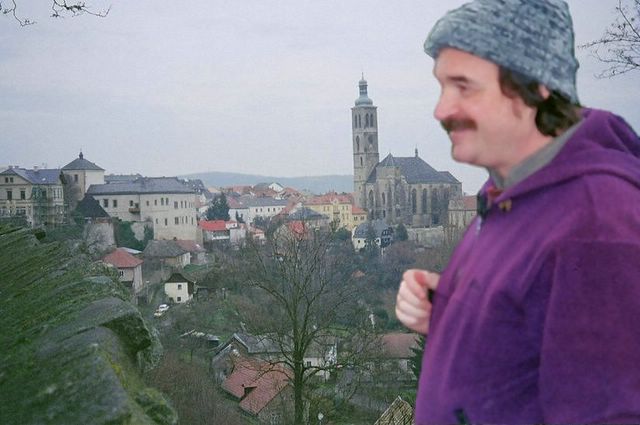
About 5 days ago I had a very vivid dream set in Prague, in the Czech Republic. It starts out with me riding on a streetcar going north within Prague.The number on the tram was 81.From the beginning the dream did not feel like a dream. It felt like I was indeed riding on a streetcar in Prague.
All the details unfolded just as in waking life; the sound of acceleration, of the doors opening, moving from stop to stop. I was talking to a friend. I had somehow set aside a coat, a wool cap and a dark file folder containing all sorts of papers, like resumes, and transcripts etc. I got off at a stop, in this conversation with a friend, forgetting to grab these items before getting off.
Somehow I begin running up the route , trying to reboard. and thanks to street lights, and scheduled stops, I finally catch up with it , and reboard the same car. I somehow communicated with an attendant what I was looking for and underneath the seats, at the very back of this two segment tram, I find the folder. Then I walk grabbing bars and over head bars , to the front and find my coat, buried under a pile of coats, with the cap tucked in a pocket.
At this point, having no wish to keep going further north I get off at the first chance I can. Upon disembarking I find I am in a far northern part of Prague, I had never been in before. Across the street I note , there is no discernible stop for an 81 tram going south. I begin walking around to try to get some sense of where I am. I walk east on a broad avenue.For a while the south side of this street has multi story buidings lining it. But then there is a gap through which I see a view.
I see that there is a wide valley between this part of Prague, and further south, with a east-west highway and train track running parallel to the street I am on. Meanwhile, as all this is unfolding it is turning from mid-afternoon to late afternoon. The sun is moving across the sky, and the quality of light in the air changes as it does as time goes by, in any sunny day.
On the north side of the street I notice an Art Museum. I go over to it just to check it out. This street is hilly so the yard has a concrete wall, so that at the high part of the block it comes to street level, but at the low part it is higher than ones head. This means, the property the Museum is on is level of course. There is little grass, growing in some of the cracks on the concrete wall. Little details like this have me experiencing this not as a dream, but as really walking around in Prague.
Next I head back up to where I got off, and then head west. I come to a street that has more residential type housing. There is a what looks like a small school or Art institute. I run into a young Czech woman on the walkway entrance and say Good Day, and also Wie Gehts. She doesn't speak English or German, so this sally gets nowhere, but she points to the building so I go inside and meet a young Czech man named Lada who speaks English. He has a 13 year old son who asks me how long I was on 81 before I got off. "Was it 12 or 15 minutes? After further explanation they drop what they are doing, we go out to a square, and they get on a different street car that takes us all to another square, where they point out a stop for #81 going south.I thank them profusely, and then after a time get on a southbound #81. Finally I arrive in a familar part of Prague. I get off, and somehow I have left my coat on the tram again. Yikes!
At this point I began leaving the dream, and found myself in my bed.
What struck me about this dream was its essential undreamlike nature. Colors and details were as precise and as vivid as moving around in Prague in waking life. When I woke up I felt like I had been in Prague for the last few hours, rather than in a dream.
Thursday, July 20, 2006
Beyond the Sky and the Earth: A Journey into Bhutan

Red Chiles at the Thimphu market
I just finished reading - - Beyond the Sky and the Earth: A Journey into Bhutan by Jamie Zeppa. I stumbled across it at our local library, not really expecting them to have much about Bhutan.
Here is a short review from over at Amazon.com:
"As a teacher of English literature, Jamie Zeppa would understand how the story of her journey into Bhutan could be fit into the convenient box of "coming-of-age romance," a romance with a landscape, a people, a religion, and a dark, irresistible student. An innocent, young Catholic woman from a Canadian mining town who had "never been anywhere," Zeppa signed up for a two-year stint teaching in a remote corner of the Himalayan kingdom of Bhutan. Despite the initial shock of material privation and such minor inconveniences as giardia, boils, and leeches, Zeppa felt herself growing into the vast spaces of simplicity that opened up beyond the clutter of modern life. Alongside her burgeoning enchantment, a parallel realization that all was not right in Shangri-La arose, especially after her transfer to a college campus charged with the politics of ethnic division. Still she maintained her center by devouring the library's Buddhist tracts and persevering in an increasingly fruitful meditation practice. When the time came for her to leave, she had undergone a personal transformation and found herself caught between two worlds that were incompatible and mutually incomprehensible. Zeppa's candid, witty account is a spiritual memoir, a travel diary, and, more than anything, a romance that retraces the vicissitudes of ineluctable passion."
I really enjoyed her descriptions of the lansdcapes of Bhutan; the mists, and the way clouds obscure and reveal the mountains and hillsides. She sees aspects of Bhutan with a sweet sensitivity. The book is especially good in her descriptions of life in Eastern Bhutan, the Pemagatshel region down near the southern border with India.
The author was working in Bhutan from 1988 thru to late 1992. Back then World University Service of Canada had Canadians teaching English in Bhutan all throughout the different regions of the country for 2 year stints.
Reading of the different accounts of her co-workers life there in really, really out of the way places in rural Bhutan, reminded me of my Peace Corps experiences, and of my short 21 days in Bhutan. Made me very envious for the experience. Punakha monastery still remains probably the most peaceful place I have ever visited on this earth.
I recommend this book highly for those interested in Bhutan. I notice some of the Amazon customer reviewers gave the author a hard time for falling in love with one of her students. However , the student was in his 'twenties' when their affair began, and love works in mysterious ways. They did end up getting married. They , 'the reviewers', just show off their late 90s political correctness to the max, but it seems inhuman and heartless to me.
The book is well written, and the author is quite honest, though it did run out of steam the last few chapters.
Here is a great quote from the book, though it does not list what Buddhist text she found this in:
And if you hit upon the idea that this or
that country is safe, prosperous, or
fortunate, give it up, my friend. . . for you
ought to know that the world is ablaze with
the fires of some faults or others. There is
certain to be some suffering . . . and a
wholly fortunate country does not exist
anywhere. Whether it be excessive cold or
heat, sickness or danger, something always
afflects people everywhere; no safe refuge
can thus be found in the world.
Saturday, July 15, 2006
Ceramic Tile painting by Fernando Andriacci

Magical art from Oaxaca, Mexico
My friend Greg was recently down in Oaxaca, Mexico, and sent me a link to
a whole bunch of photos taken while down there. This photo is of a ceramic tile painting done by Fernando Andriacci. Wild and whimsical stuff.
There is a link for his art at: Oaxaca Mexico Art.

Wednesday, July 12, 2006
Shine on Syd

It is obvious
may I say, oh baby, that it is found on another plane?
"The poppy birds way swing twigs coffee brands around.
Brandish her wand with a feathery tongue.
My head kissed the ground
I was half the way down, treading the sand,
please... Please, please lift the hand
I'm only a person with Eskimo chain
I tattooed my brain all the way...
Won't you miss me?
Wouldn't you miss me at all? - - from Dark Globe by Syd Barrett
I heard yesterday that Syd Barrett, who just turned 60, on July 6th had left his mortal coil. Now he belongs to the ages. I , in a certain way was helped by his music; I remember listening to his double album Barrett , and the Madcap Laughs, a lot in the period 1976 thru 1977, as I tried to adjust to Houston after 4 years in Austin.
I mean, I think anyone who has gone to the edge, or tripped out can appreciate some of Syd's songs, and his lyrics were poetry, of the British eccentric sort. Of course anyone who lived through the 1970s must have heard Pink Floyd's Dark Side of the Moon. It is one of the longest selling albums of all time. But, A Piper at the Gates of Dawn, Barrett, and ' The Madcaps laughs' were never all that well known, though they attained 'cult' status.
I have noticed there have been tributes to Syd all over the Web, while television, has fairly ignored his passing. I would imagine the BBC in England probably did better. In todays Zeitgest, it is as if it is impossible to talk about LSD, Barretts life, and career, his descent into incoherence on TV. At any rate doing a Google news search I did find a fairly good tribute by Richard Jinman. here are a few excerpts from:
The second death of a boy genius
"There are, or rather were, two Syd Barretts. The first, the one the fans prefer to remember, was a young, handsome, prodigiously gifted musician from an English university town who formed a group called Pink Floyd in 1965 and quickly became the undisputed leader of Britain's nascent psychedelic rock scene. It was a part he seemed born to play. Wearing the silk and velvet robes of London's hippy aristocracy, a Fender Telecaster slung around his slender shoulders, he wrote the Floyd's two early hit singles, Arnold Layne and See Emily Play.
The other Syd Barrett was a balding, slightly corpulent man who lived in the basement of his mother's Cambridge house, devoting himself to gardening and painting. This was the post-Floyd Barrett, the man who was ousted from the band in 1968 after he fried his brain on LSD and became so erratic his bandmates - the former architecture students who would go on to define 1970s rock with albums such as Dark Side of the Moon and Wish You Were Here - believed he had slipped beyond their help. This Barrett managed to record two shambolically brilliant solo albums ( The Madcap Laughs and Barrett) full of off-kilter, whimsical and distinctively English songs with titles such as Effervescing Elephant, Baby Lemonade and Terrapin. After that, silence. Barrett turned his back on music, London and the world."
Here are other small statements which I add to this post at this point: Meanwhile, David Gilmour said: "We are very sad to say that Roger Keith Barrett - Syd - has passed away."Do find time today to play some of Syd's songs and to remember him as the madcap genius who made us all smile with his wonderfully eccentric songs about bikes, gnomes and scarecrows. "His career was painfully short, yet he touched more people than he could ever know."
And Roger Waters said," He leaves behind a body of work that is both very touching and very deep. It will shine on forever."
Elsewhere, David Bowie commented: "I can't tell you how sad I feel. The few times I saw him perform in London at UFO and the Marquee clubs during the '60s will forever be etched in my mind. "He was so charismatic and such a startlingly original songwriter. Also, along with Anthony Newley, he was the first guy I'd heard to sing pop or rock with a British accent. "His impact on my thinking was enormous. A major regret is that I never got to know him. A diamond indeed."
"A few weeks ago former bandmate Roger Waters dedicated a song to Barrett at the Hyde Park Calling festival in London, 25,000 people from every conceivable background knew every word to the chorus of 'Shine On You Crazy Diamond' - a fitting coda to the life of a flawed but much admired genius.
And this: " Barrett's death makes him a mystery to the end. Unlike the other mad geniuses of the psychedelic era - Brian Wilson, Roky Erickson and Love's Arthur Lee - Barrett never came back from the edge."
One of the things I learn from Mr. Barrett and his poetry, is his courage in showing such human vulnerability, in being so authentic, just before he went silent for good. I sometimes wonder if for the rest of his time on earth,from say 1973 until he died, he lived in a time at right angles to the sense of time our Western world moves along in. Those 2 albums of his were so uncommercial, in a way an antithesis of much that was popular then or now.
I always really liked Golden Hair:
GOLDEN HAIR (These lyrics are originally from "Chamber Music" by James Joyce (1907)
Lean out your window, golden hair
I heard you singing in the midnight air
my book is closed, I read no more
watching the fire dance, on the floor
I've left my book, I've left my room
For I heard you singing through the gloom
singing and singing, a merry air
lean out the window, golden hair...
The corporate media will frame his life in a certain slamdunk, I told you so, tale of artist gone to ruin way. But they will never explore his songs very much, because they are too human, plaintitive, but whimsical, edgy, but not catchy enough to ever be able to push some product. And those who appreciate his music will go on listening to it.
May he rest in peace, a tormented soul, but a poetic soul, who pushed the boundaries , and took on the steel rail for a while. The Crazy Diamond is gone. May he shine on in new realms. Though this post is way long I will add some more lyrics:
SHE TOOK A LONG COLD LOOK
She took a long cold look at me and smiled
and gazed all over my arm she loves to see me get down to ground
she hasn't time just to be with me
her face between all she means to be to be extreme, just to be extreme
a broken pier on the wavy sea
she wonders why for all she wants to see...
But I got up and I stomped around and hid the piece
where the trees touch the ground...
The end of truth that lay out the time
spent lazing here on a painting dream
a mile or more in a foreign clime
to see farther inside of me.
And looking high up into the sky
I breathe as the water streams over me...
Wednesday, July 05, 2006
Godzilla vs. Megalon

Meeting of Minds
I note with interest that the next Rhino release of Mystery Science Theater 3000, is going to contain - - - Godzilla vs. Megalon.
Here is the announcement at Satellite News:
We now have definitive word about The Mystery Science Theater 3000 Collection: Volume 10! Gonna be a good one! Episodes are:
212- GODZILLA VS. MEGALON
503- SWAMP DIAMONDS (plus short: WHAT TO DO ON A DATE)
514- TEEN-AGE STRANGLER (plus short: IS THIS LOVE?)
810- THE GIANT SPIDER INVASION
Well , Godzilla vs. Megalon, at least , the MYST3K version has long been one of my favorites.
Here is an synopsis, for the uninitiated, or those that have missed seeing this cultural artifact:
"In the film, the undersea civilization Seatopia has been heavily affected by nuclear testing conducted by the surface nations of the world. Naturally upset by this, they unleash their civilization's protector, Megalon, to the surface to destroy those who would — unknowingly or not — destroy them. Agents of Seatopia attempt to steal the newly-constructed super-robot Jet Jaguar, which can apparently be used to guide and direct Megalon. They also capture the robot's inventor, Goro Ibuki, his kid brother Rokuro and their friend Hiroshi Jinkawa. After Jet Jaguar is used by the Seatopians to lure Megalon to Tokyo, Goro manages to regain control, and sends Jet Jaguar to Monster Island to bring Godzilla back to fight Megalon. An extended fight scene then takes place, with Godzilla and Jet Jaguar, the latter newly giant-sized and self-directed, fighting Megalon and Gigan in the hills outside Tokyo. The film ends with Megalon and Gigan defeated, Godzilla returning to Monster Island, and Jet Jaguar returning to his previous, human-sized state."
Okay, okay with this post I may have jumped the shark, or the Gigan so to speak, but I continue to collect Mystery Science Theater 3K episodes, and am a die hard fan. The Godzilla vs. Megalon episode is a total hoot, plus you get tag team wrestling of Godzilla and Jet Jaguar versus Megalon and Gigan.
The scene where Megalon is summoned up from the depths of Hades by the High Priest of Seatopia is priceless, priceless! A moment for the ages.
JP sez, check it out.
Thursday, June 29, 2006
Chorten in Bhutan, Oct.1992
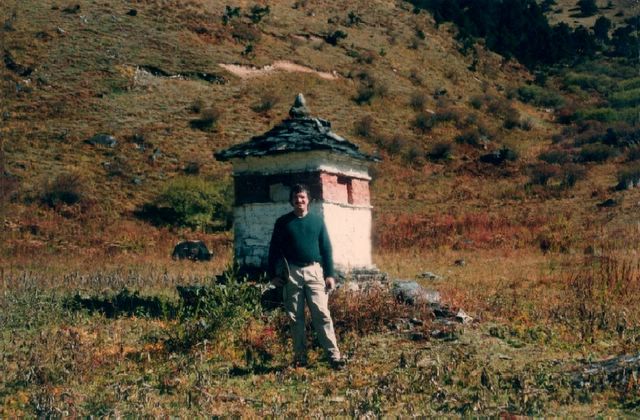
One of my old friends, Bari, who finished up two years in Peace Corps Mongolia, is now talking about going back, and it sounds like getting married there too.
I thought I would send him via e-mail , this photo of the author of this blog, in front of a small chorten on the path up to Chomolhari, taken in October of 1992. Fourteen years ago, and all those days still seem fresh, to me. It just goes to show how pleasant memories, are remembered more readily.
I miss Bhutan at times, and wonder about Sangjay Khandu, our trek guide.
Guess, I'll have to look up Kuensel on the Web sometime.
Monday, June 26, 2006
Genealogy post- Greenberry Pinkston
GREENBERRY PINKSTON was born 1772 in Union County, SC, and died on July 27, 1852 in Mt. Meigs, AL. He married his first wife : Mary Ann Key Armstrong on December 25, 1796 in Hancock Co., GA.
By 1785 His Father John Pinkston (1744-1803) had moved the family to Wilkes County , Georgia , and by 1793 land records show them as being in Hancock County, Georgia .
I recently found a small amount of information about him in the book-
Recollections of the Early Settlers of Montgomery County and Their Families, by W.G. Robertson,
1892.
Here it is:" Green Pinkston
Green Pinkston , one of the first settlers, was a member of the Baptist church and lived in the vicinity of old
Antioch church, and had his membership there. He was a strong supporter of his church and a man that was
respected by every one who knew him. Mr. Pinkston had a family of four sons and three daughters.
James, one of his sons, married a Miss Mosely. Franklin, a splendid young man, married a Miss Hopper, and
John married a Miss Ray. Ann, the oldest daughter, married John Harper. Dolly, the next, married Frank
Howard, a good citizen and farmer. Evelin, the youngest, married William McClemore. Mr. Pinkston lived to a ripe old age and gently passed from earth."
In 1812, Land Tax Records show him as living still in Hancock Cnty. ,GA.
His eldest daughter, Martha Dolly Pinkston, was born 3 Feb 1813 in Montgomery, County, Alabama, which would indicate in the latter part of 1812, the family moved from Georgia, to Montgomery Cnty., Alabama.
It looks like he spent the remainder of his life in Mt. Meigs, Alabama, living near the Antioch Baptitist Church along the old Line Road.
Greenberry would either be my great, great , great grandfather or great, great, great grand Uncle. It all depends upon who is assigned as being the father of Henry B. Pinkston, (1828 -Jan. 1, 1887) my Great, Great Grandfather.
Which means that I will likely add to, or update this post at some point in the future.
Well, I just added an update to this. I finally found a death date for him in:`Marriage and Death Notices From the "South Western Baptist" Newspaper . Thus: " Died at the residence of his son in Montgomery County, Alabama on the 27th of July last, Deacon Green B. Pinkston, in the eighty first year of his age, having been a member of the Antioch Church thirty years and a deacon twenty eight."
Also I came across this information about him in a book entitled Early Alabama Settlers: " Granted land in Montgomery County, AL. Territory in 1817. He moved to MT. Meigs at that time along with his brother James and Mary Ann's brothers, James W. Armstrong, Mack Armstrong and her sister Miriam A. Vickers".
By 1785 His Father John Pinkston (1744-1803) had moved the family to Wilkes County , Georgia , and by 1793 land records show them as being in Hancock County, Georgia .
I recently found a small amount of information about him in the book-
Recollections of the Early Settlers of Montgomery County and Their Families, by W.G. Robertson,
1892.
Here it is:" Green Pinkston
Green Pinkston , one of the first settlers, was a member of the Baptist church and lived in the vicinity of old
Antioch church, and had his membership there. He was a strong supporter of his church and a man that was
respected by every one who knew him. Mr. Pinkston had a family of four sons and three daughters.
James, one of his sons, married a Miss Mosely. Franklin, a splendid young man, married a Miss Hopper, and
John married a Miss Ray. Ann, the oldest daughter, married John Harper. Dolly, the next, married Frank
Howard, a good citizen and farmer. Evelin, the youngest, married William McClemore. Mr. Pinkston lived to a ripe old age and gently passed from earth."
In 1812, Land Tax Records show him as living still in Hancock Cnty. ,GA.
His eldest daughter, Martha Dolly Pinkston, was born 3 Feb 1813 in Montgomery, County, Alabama, which would indicate in the latter part of 1812, the family moved from Georgia, to Montgomery Cnty., Alabama.
It looks like he spent the remainder of his life in Mt. Meigs, Alabama, living near the Antioch Baptitist Church along the old Line Road.
Greenberry would either be my great, great , great grandfather or great, great, great grand Uncle. It all depends upon who is assigned as being the father of Henry B. Pinkston, (1828 -Jan. 1, 1887) my Great, Great Grandfather.
Which means that I will likely add to, or update this post at some point in the future.
Well, I just added an update to this. I finally found a death date for him in:`Marriage and Death Notices From the "South Western Baptist" Newspaper . Thus: " Died at the residence of his son in Montgomery County, Alabama on the 27th of July last, Deacon Green B. Pinkston, in the eighty first year of his age, having been a member of the Antioch Church thirty years and a deacon twenty eight."
Also I came across this information about him in a book entitled Early Alabama Settlers: " Granted land in Montgomery County, AL. Territory in 1817. He moved to MT. Meigs at that time along with his brother James and Mary Ann's brothers, James W. Armstrong, Mack Armstrong and her sister Miriam A. Vickers".
Monday, June 19, 2006
Two columns that caught my attention
I was struck by the ending of one of George Wills recent column's entitled:
Iraq's Atomization:
"But it did not take three years of Zarqawi and terrorism and sectarian violence to turn Iraqis into difficult raw material for self-government. For that, give another devil his due: Saddam Hussein's truly atomizing tyranny and terror. On June 20, 2003, just 72 days after the fall of Baghdad, The Post reported this from Fallujah:
"Military engineers recently cleared garbage from a field in Fallujah, resurfaced it with dirt and put up goal posts to create an instant soccer field. A day later, the goal posts were stolen and all the dirt had been scraped from the field. Garbage began to pile up again."
An Army captain asked, "What kind of people loot dirt?" There are many answers to that question. Here is one: a kind of people who are hard to help."
Then week after week Sidney Blumenthal disects everything 'W' does, and clarifies what is really going on. Here's the final part of a column entitled: George Bush Sr. asked retired general to replace Rumsfeld :
(At the beginning of the column he recounted behind the scenes efforts of Bush Sr. to ease out Rumsfeld)
"As Bush's approach has stamped failure on the military, he insists ever more intensely on the inevitability of victory if only he stays the course. Ambiguity and flexibility, essential elements of any strategy for counterinsurgency, are his weak points. Bush may imagine a scene in which the insurgency is conclusively defeated, perhaps even a signing ceremony, as on the USS Missouri, or at least an acknowledgment, a scrap of paper, or perhaps the silence of the dead, all of them. But his infatuation with a purely military solution blinds him to how he thwarts his own intentions. Jeffrey Record, a prominent strategist at a U.S. military war college, told me: "Perhaps worse still, conventional wisdom is dangerously narcissistic. It completely ignores the enemy, assuming that what we do determines success or failure. It assumes that only the United States can defeat the United States, an outlook that set the United States up for failure in Vietnam and for surprise in Iraq.
Bush's abrogation of the Geneva Conventions has set an example that in this unique global war on terror, in order to combat those who do not follow the rules of war, we must also abandon those rules. This week a conflict has broken out in the Pentagon over Rumsfeld's proposed revision of the Army Field Manual for interrogation of prisoners, which would excise Common Article Three of the Geneva Conventions that forbids "humiliating and degrading treatment." And, this week, Sen. Carl Levin, D-Mich., proposed a bill that would make the administration provide "a full accounting on any clandestine prison or detention facility currently or formerly operated by the United States Government, regardless of location, where detainees in the global war on terrorism are or were being held," the number of detainees, and a "description of the interrogation procedures used or formerly used on detainees at such prison or facility and a determination, in coordination with other appropriate officials, on whether such procedures are or were in compliance with United States obligations under the Geneva Conventions and the Convention Against Torture." The administration vigorously opposes the bill.
Above all, the Bush way of war violates the fundamental rule of warfare as defined by military philosopher Carl von Clausewitz: War is politics by other means. In other words, it is not the opposite of politics, or its substitute, but its instrument, and by no means its only one. "Subordinating the political point of view to the military would be absurd," wrote Clausewitz, "for it is policy that creates war. Policy is the guiding intelligence and war only the instrument, not vice versa."
Rumsfeld's Pentagon, meanwhile, reinforces Bush's rigidity as essential to "transformational" warfare; by now, however, the veneer has been peeled off to reveal sheer self-justification. Rumsfeld is incapable of telling the president that there is no battle, no campaign, that can win the war. Saving Rumsfeld is Bush's way of staying the course. But it also sends a signal of unaccountability from the top down. The degradation of U.S. forces in Iraq is a direct consequence of the derangement of political leadership in Washington. And not even the elder Bush can persuade the president that his way of war is a debacle."
Really an excellent column. I recommend checking out Salon each week, if for nothing else, at least Sidney Blumenthals columns. There are a lot of other excellent articles there too.
Iraq's Atomization:
"But it did not take three years of Zarqawi and terrorism and sectarian violence to turn Iraqis into difficult raw material for self-government. For that, give another devil his due: Saddam Hussein's truly atomizing tyranny and terror. On June 20, 2003, just 72 days after the fall of Baghdad, The Post reported this from Fallujah:
"Military engineers recently cleared garbage from a field in Fallujah, resurfaced it with dirt and put up goal posts to create an instant soccer field. A day later, the goal posts were stolen and all the dirt had been scraped from the field. Garbage began to pile up again."
An Army captain asked, "What kind of people loot dirt?" There are many answers to that question. Here is one: a kind of people who are hard to help."
Then week after week Sidney Blumenthal disects everything 'W' does, and clarifies what is really going on. Here's the final part of a column entitled: George Bush Sr. asked retired general to replace Rumsfeld :
(At the beginning of the column he recounted behind the scenes efforts of Bush Sr. to ease out Rumsfeld)
"As Bush's approach has stamped failure on the military, he insists ever more intensely on the inevitability of victory if only he stays the course. Ambiguity and flexibility, essential elements of any strategy for counterinsurgency, are his weak points. Bush may imagine a scene in which the insurgency is conclusively defeated, perhaps even a signing ceremony, as on the USS Missouri, or at least an acknowledgment, a scrap of paper, or perhaps the silence of the dead, all of them. But his infatuation with a purely military solution blinds him to how he thwarts his own intentions. Jeffrey Record, a prominent strategist at a U.S. military war college, told me: "Perhaps worse still, conventional wisdom is dangerously narcissistic. It completely ignores the enemy, assuming that what we do determines success or failure. It assumes that only the United States can defeat the United States, an outlook that set the United States up for failure in Vietnam and for surprise in Iraq.
Bush's abrogation of the Geneva Conventions has set an example that in this unique global war on terror, in order to combat those who do not follow the rules of war, we must also abandon those rules. This week a conflict has broken out in the Pentagon over Rumsfeld's proposed revision of the Army Field Manual for interrogation of prisoners, which would excise Common Article Three of the Geneva Conventions that forbids "humiliating and degrading treatment." And, this week, Sen. Carl Levin, D-Mich., proposed a bill that would make the administration provide "a full accounting on any clandestine prison or detention facility currently or formerly operated by the United States Government, regardless of location, where detainees in the global war on terrorism are or were being held," the number of detainees, and a "description of the interrogation procedures used or formerly used on detainees at such prison or facility and a determination, in coordination with other appropriate officials, on whether such procedures are or were in compliance with United States obligations under the Geneva Conventions and the Convention Against Torture." The administration vigorously opposes the bill.
Above all, the Bush way of war violates the fundamental rule of warfare as defined by military philosopher Carl von Clausewitz: War is politics by other means. In other words, it is not the opposite of politics, or its substitute, but its instrument, and by no means its only one. "Subordinating the political point of view to the military would be absurd," wrote Clausewitz, "for it is policy that creates war. Policy is the guiding intelligence and war only the instrument, not vice versa."
Rumsfeld's Pentagon, meanwhile, reinforces Bush's rigidity as essential to "transformational" warfare; by now, however, the veneer has been peeled off to reveal sheer self-justification. Rumsfeld is incapable of telling the president that there is no battle, no campaign, that can win the war. Saving Rumsfeld is Bush's way of staying the course. But it also sends a signal of unaccountability from the top down. The degradation of U.S. forces in Iraq is a direct consequence of the derangement of political leadership in Washington. And not even the elder Bush can persuade the president that his way of war is a debacle."
Really an excellent column. I recommend checking out Salon each week, if for nothing else, at least Sidney Blumenthals columns. There are a lot of other excellent articles there too.
Sunday, June 11, 2006
Traveling by Book

Well when a Sagittarius can't do much traveling due to circumstances, then they tend to do traveling by book. Thus, I picked up Robert D. Kaplan's The Ends of the Earth: A Journey at the Dawn of the Twenty-first Century .
A travel book, but more than that, Kaplan visits places most travelers aren't going to at the moment. Here's the mini review from Amazon.com, which was originally from Publishers Weekly:
" After his recent travels through troubled southeastern Europe, Kaplan (Balkan Ghosts: A Journey Through History) has taken on an even more ambitious itinerary-some of the most inhospitable regions of the globe, both geographically and politically. Starting in West Africa, where he finds that border regions are so porous as to make the concept of countries "largely meaningless," he braves the Egyptian desert, then advances through Turkey, Azerbaijan, Iran, sprawling Turkestan, China and Pakistan and on through Southeast Asia. He advises at the outset that his book "folds international studies into a travelogue." Readers looking for an easy ride had better fasten their seat belts, for the author treats us to all sorts of speculation on the condition of humankind as the century is about to turn, along with generous dollops of history. Intermingled with graphic descriptions of exotic locales are highly personal ruminations, one of the most interesting of which is that in some of these lands, "the village came to the city and . . . vanquished it" by overwhelming modern urban middle-class values. A challenging and engrossing read."
I had been reading Constantine the Great, by Michael Grant, and Faust Theater of the World, and Struggle for Europe by Chester Wilmot, but once I got Ends of the Earth, it shot to the top of my reading stack so to speak.
Hard to put down. I have read several of Robert Kaplans books and I find them all engrossing and pleasurable reads. He brings valuable insights from his study of history , literature and art, to every country he visits.
One of the chapters which describes his adventures in Sinkiang, is called "Strategic Hippie Routes"; it would seem that back in 1994, when he was trying to get to Kashgar, the only westerners he ran into in the remote areas of Sinkiang were backpacking neo-hippies.
If I haven't been blogging as much, is I get involved in some good summer reading, or as I say traveling by books.
Friday, June 02, 2006
Excerpts from a Gore Vidal Interview
Didn't blog much in May, but now I am adding some excerpts from a Gore Vidal interview I found on the web. Usually each week I try to check what Hendrick Hertzberg at the New Yorker, or Sidney Blumethal at Salon.com are saying. Vidal or course is now an Elder man of letters, and always has his own unique take on these United States, especially considering his deep, and long developed study of U.S. History.
The interviewer is Kam Williams, and it was found over at: http://eurweb.com/story/eur26667.cfm . Here is a sample:
"KW: How would you describe the State of the Union?
GV: This is an Empire gone berserk. You've got a President who had every intention of militarizing the economy and militarizing the society. This had nothing to do with governance. He was mostly smearing people who pointed out his shortcomings. Now we don't have the money anymore… We don't have the will… People are disgusted… Katrina has turned off half a nation… And there's all the nonsense about borders… and so on… This is the worst period that I've ever seen for the United States. And Marcy Winograd, at least, is a good candidate who is intelligent.
KW: What do you think was Bush's agenda for this Presidency he wanted by any means necessary?
GV: To give his corporate friends jobs and tax cuts, from the oil people to General Electric. To make sure Halliburton wouldn't have to bid on its contracts to rebuild a country we first knocked-down with our tax dollars.
KW: By deliberately ruining Iraq so war profiteers could rebuild its infrastructure, he ended up ruining this country in the process, given the record federal deficit, which is why so much of the Gulf Region looks the same as the day after Hurricane Katrina hit. I wonder whether Bush has a sense of the irony about that.
GV: He has no sense at all. That's the problem. I don't think he deliberately set out to wreck the United States, but he has. It'll take two generations to get this country back, if we can ever get it back.
KW: Why aren't the people up in arms?
GV: Acquiescence. What used to be called citizens are now just a bunch of consumers waiting to be told what to do next, and automatically voting, even though they know the machinery is going to reverse their vote. We've lost too much in the way of the Bill of Rights.
KW: How do you think Bush feels about his disastrous Presidency?
GV: I don't think he cares. There are so many different kinds of stupidity. In American politics, you get to meet every kind. But he's a little exceptional. Very few politicians who got to be president are as ignorant as he is. Usually, they knew something about economics, something about the world works. I would say even some of them have a bit of conscience, not much, not much, and talk about impossible dreams. Aside from ambition, they do have an idea that they're going to serve a certain group.
KW: How has this played out with Bush?
GV: So, if there's a really difficult job, like running FEMA, you pick the dumbest person you know, because he's a really good guy. To watch Bush do this time and time again, I sit there and my jaw drops. Each time he does it he's in deeper trouble. He learns nothing.
KW: What will be the Bush legacy?
GV: If you remember, in one of my other books, I prophesied at the time of his election in 2000, "He will leave office the most hated President in our history."
KW: How'd you know?
GV: I put it together just from things he was saying along the way and from what I knew of his career in Texas."
The interviewer is Kam Williams, and it was found over at: http://eurweb.com/story/eur26667.cfm . Here is a sample:
"KW: How would you describe the State of the Union?
GV: This is an Empire gone berserk. You've got a President who had every intention of militarizing the economy and militarizing the society. This had nothing to do with governance. He was mostly smearing people who pointed out his shortcomings. Now we don't have the money anymore… We don't have the will… People are disgusted… Katrina has turned off half a nation… And there's all the nonsense about borders… and so on… This is the worst period that I've ever seen for the United States. And Marcy Winograd, at least, is a good candidate who is intelligent.
KW: What do you think was Bush's agenda for this Presidency he wanted by any means necessary?
GV: To give his corporate friends jobs and tax cuts, from the oil people to General Electric. To make sure Halliburton wouldn't have to bid on its contracts to rebuild a country we first knocked-down with our tax dollars.
KW: By deliberately ruining Iraq so war profiteers could rebuild its infrastructure, he ended up ruining this country in the process, given the record federal deficit, which is why so much of the Gulf Region looks the same as the day after Hurricane Katrina hit. I wonder whether Bush has a sense of the irony about that.
GV: He has no sense at all. That's the problem. I don't think he deliberately set out to wreck the United States, but he has. It'll take two generations to get this country back, if we can ever get it back.
KW: Why aren't the people up in arms?
GV: Acquiescence. What used to be called citizens are now just a bunch of consumers waiting to be told what to do next, and automatically voting, even though they know the machinery is going to reverse their vote. We've lost too much in the way of the Bill of Rights.
KW: How do you think Bush feels about his disastrous Presidency?
GV: I don't think he cares. There are so many different kinds of stupidity. In American politics, you get to meet every kind. But he's a little exceptional. Very few politicians who got to be president are as ignorant as he is. Usually, they knew something about economics, something about the world works. I would say even some of them have a bit of conscience, not much, not much, and talk about impossible dreams. Aside from ambition, they do have an idea that they're going to serve a certain group.
KW: How has this played out with Bush?
GV: So, if there's a really difficult job, like running FEMA, you pick the dumbest person you know, because he's a really good guy. To watch Bush do this time and time again, I sit there and my jaw drops. Each time he does it he's in deeper trouble. He learns nothing.
KW: What will be the Bush legacy?
GV: If you remember, in one of my other books, I prophesied at the time of his election in 2000, "He will leave office the most hated President in our history."
KW: How'd you know?
GV: I put it together just from things he was saying along the way and from what I knew of his career in Texas."
Tuesday, May 30, 2006
Hinduism, Rebirth, and Time
Was reading a book about Hinduism and came across this little tidbit, which I had never encountered before:
"Don't assume that re-incarnation takes place in linear time. Remember , to the Hindu, time and space are multi-dimensional. According to a Hindu classic called the Yoga Vaisistha, your next incarnation, or your last incarnation for that matter, may be happening right now. Your next life may occur in the past! This is because your innermost spirit exists outside of time and space, and can travel to wherever and to whenever it wants!"
Well, I guess I have always just sort of assumed linear time. Of course this correlates withe the Tibetan idea of the Bardo, which for the Bardo between lives is outside of linearly experienced time and space.
Am not sure I would want to be reborn in the 1800s though. And this raises all sorts of ancestor incest issues. Time travel Sci-Fi writers have tackled some of these issues, but I had not encountered this Hindu idea until now. Mind-boggling in its ramifications though!
"Don't assume that re-incarnation takes place in linear time. Remember , to the Hindu, time and space are multi-dimensional. According to a Hindu classic called the Yoga Vaisistha, your next incarnation, or your last incarnation for that matter, may be happening right now. Your next life may occur in the past! This is because your innermost spirit exists outside of time and space, and can travel to wherever and to whenever it wants!"
Well, I guess I have always just sort of assumed linear time. Of course this correlates withe the Tibetan idea of the Bardo, which for the Bardo between lives is outside of linearly experienced time and space.
Am not sure I would want to be reborn in the 1800s though. And this raises all sorts of ancestor incest issues. Time travel Sci-Fi writers have tackled some of these issues, but I had not encountered this Hindu idea until now. Mind-boggling in its ramifications though!
Subscribe to:
Posts (Atom)